Tag:amenity=charging station
 amenity = charging_station amenity = charging_station |
 |
| Description |
|---|
A station that supplies energy to electrical vehicles.  |
| Rendering in OSM Carto |
 |
| Group: Amenities |
| Used on these elements |
    |
| Useful combination |
|
| See also |
|
Status: de facto |
| Tools for this tag |
|


Charging stations supply energy for electric vehicles, like gas stations do for conventional vehicles.
There are some different types of charging stations.  E-bikes e.g. can be charged at a domestic wall socket.
How to map
Add a node at the centre of the charging station or create a way around the charging station area . Add the tag amenity=charging_station to the node or way.
Time-saving feature types exist for some charging networks. When you search for and select one of these, you automagically get brand icon, pre-filled brand and name fields, the charging_station tag). Available for: Blink, ChargePoint, EVgo, Tesla Supercharger, perhaps others. (Feature type wish list: U.S.: ChargeNet, Electrify America, Electric Highway Coalition (16 states), EV Connect, SemaConnect, Volta. Europe: Fastned, Ionity, others. Other main international, national, regional providers, like upcoming Shell, BP networks.)
Tags to use in combination
Like the amenity=fuel tag, it is helpful to add the location of the amenity=charging_station. At a later time, specific details of the amenity=* can be added. Charging cars takes time depending on the maximum power output of the station, the number of vehicles currently charging and the charging level of the battery. Providing the number of vehicles that can be charged at the same time through the capacity=* tag will be the next most useful tag.
Electric vehicle charging is such a young market that the standards are changing rapidly. Mappers that do not use the technology will have a tough time sorting the details of the sockets, voltage, current, and billing networks. Operators of electric vehicles may need a toolkit of adapters for the types of sockets and charging systems that are used in their local area.
- brand=* - The brand name of the station.
- manufacturer=* The manufacturer of the equipment (e.g. Tritium)
- operator=* - The name of the operator of the station.
- network=* - The name of the Network, with that the operator cooperates.
- capacity=* - The number of vehicles which can be charged at the same time. The total number of sockets can be higher.
- ref=*
- ref:EU:EVSE=* - EU-wide reference number for charging stations
- socket:<type>=number - Number of this socket type. There may be several socket types.
- socket:<type>:current=ampere - The current of the respective plug.
- socket:<type>:output=watt - The electric power output of the respective plug.
- socket:<type>:voltage=volt - The voltage of the respective plug.
- fee=yes/no/donation - Yes if some or all customers have to pay a fee for using the station. Donation model also possible.
- charge=* - To specify the fee amount if fee=yes. Example usage: fee=yes + charge=0.35 USD/kWh.
- parking:fee=yes/no/interval - Whether you have to pay a parking fee or not while charging. If the fee must be paid only on certain hours, the same syntax can be used as for opening hours.
- opening_hours=*
- payment=*
- maxstay=* - Maximum time you are allowed to stay.
Note for the renderers: older versions of this page referred to amperage=* and voltage=* instead of socket:<type>:current=ampere and socket:<type>:voltage=volt respectively. These tags are still found in a number of charging station POIs. However that scheme did not allow for multiple socket types with different current and voltages.
Power output
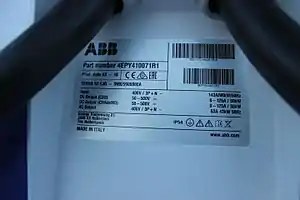
- To specify the maximum output of the entire station: charging_station:output=xxx kW This value can often be found on the back of the station.
- For each socket type extend it like socket:type2:output=xxx kW
Vehicles
- Main article: Key:access § Land-based transportation
For providing the information, which types of vehicles can be charged.
- bicycle=yes - electric bikes (also called pedelec) can be charged
- moped=yes - electric mopeds (scooters) can be charged
- motorcar=yes - electric cars can be charged
- motorcycle=yes - electric motorcycles can be charged
- hgv=yes - electric trucks can be charged (this is about providing enough space so that HGV will fit)
- bus=yes - electric buses can be charged. If the facility is only for buses, use access=no + bus=designated
- small_electric_vehicle=yes - small electric vehicles can be charged
Authentication and payment
- Main article: Key:authentication
- Main article: Key:payment
Some charging stations require authentication, even if charging is for free. Different operators use different authentication mechanisms for their charging stations. Some charging stations even support several authentication mechanisms, and the user can choose which to use.
Examples
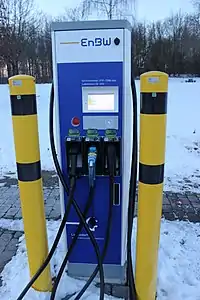
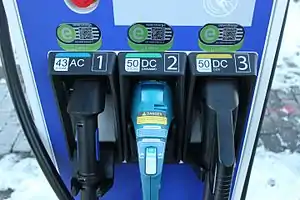
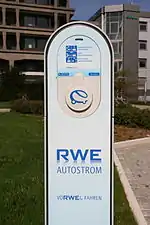
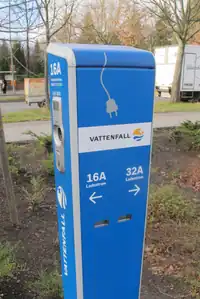
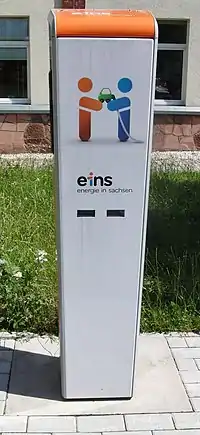
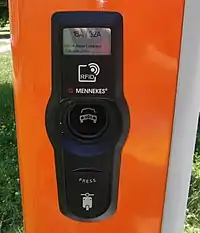
United States
The following table provides an example of tags to consider and how they can be added to a node when mapping a amenity=charging_station. The first row of the table shows a minimal set of useful tags to add to the amenity=charging_station node. Building up a detailed set of tags may take more time to gather than you have time for during an area survey.
| Image | Tags | Notes |
|---|---|---|
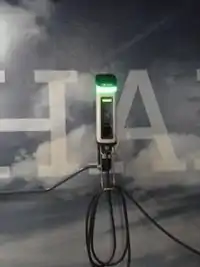 |
amenity=charging_station capacity=1 |
Adding just the amenity=charging_station tag to the node adds the amenity to the map. The capacity=* is useful because of long "fueling" times. Some stations support two or more "nozzles". The capacity=1 tag states how many cars can be served from the station at the same time. 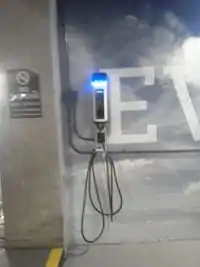 The SemaConnect Charge Pro station provides a status beacon to approaching cars. A blue status colour means that the charger is available. A green status colour means that the charger is in use. |
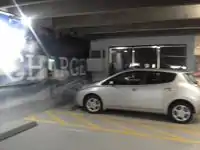 |
amenity=charging_station capacity=1 bicycle=no motorcar=yes scooter=no hgv=yes covered=yes |
The type of vehicles are another set of useful tags to add to the minimum station information. Pedestrians are not allowed in the parking garage where these units are located. Bicycle and scooters more than likely will not be supported. Adding the covered=* tag helps the driver find more desirable charging locations. |
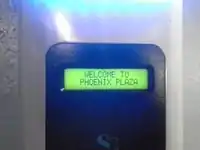 |
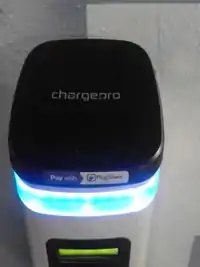
amenity=charging_station capacity=1 bicycle=no motorcar=yes scooter=no hgv=yes covered=yes operator=Phoenix Plaza Building network=SemaConnect |
SemaConnect/SemaCharge encourages building owners and employers to install charging stations. In this case the operator is the Phoenix Plaza Building. The network=* tag may be useful for network identification. Some of the possible networks are
One of the confusing aspects of the network is the network used for billing or location purposes. |
 |
amenity=charging_station capacity=1 bicycle=no motorcar=yes scooter=no hgv=yes covered=yes operator=Phoenix Plaza Building network=SemaConnect payment:credit_cards=yes payment:debit_cards=yes |
 |
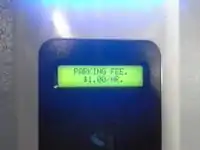 |
amenity=charging_station capacity=1 bicycle=no motorcar=yes scooter=no hgv=yes covered=yes operator=Phoenix Plaza Building network=SemaConnect payment:credit_cards=yes payment:debit_cards=yes fee=yes parking:fee=yes |
The fee=yes tag was added along with a tag for the required parking building fee. There are some sites that do not charge a fee for the "fill-up". The charging station may be more of a marketing feature of the site than a revenue generating station. In this case, fee=no would be useful. You would want to add one of the authentication tags. The payment account is used to safely turn on this system to protect against electrocution. In addition to the "fill-up" fee, a parking:fee=yes tag was added. The first three hours are 1 USD an hour. After the first three hours, then rate changes to 3 USD an hour. |
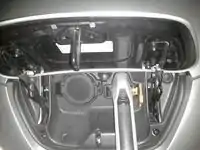 |
amenity=charging_station capacity=1 bicycle=no motorcar=yes scooter=no hgv=yes covered=yes operator=Phoenix Plaza Building network=SemaConnect payment:credit_cards=yes payment:debit_cards=yes fee=yes parking:fee=yes socket:type2_cable=1 socket:type2_cable:amperage=30 socket:type2_cable:voltage=240 |
The Nissan Leaf has its charging hood open. The left side of the hood has a receptacle for a chademo plug that is still covered. The J1772-2009 receptacle has a type1 plug connected to it.
 |
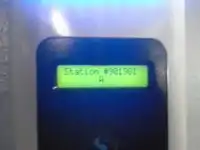 |
amenity=charging_station capacity=1 bicycle=no motorcar=yes scooter=no hgv=yes covered=yes operator=Phoenix Plaza Building network=SemaConnect payment:credit_cards=yes payment:debit_cards=yes fee=yes parking:fee=yes socket:type2=1 socket:type2:amperage=30 socket:type2:voltage=240 ref=Station #901981 A wheelchair=yes |
Two more useful tags at this site. The station reference number starts with #901981. One unit has an A and the other has a B added to differentiate the two units. A wheelchair=* tag was added. The stations are wheelchair accessible. The parking spaces have diagonal yellow strips making the required room for a wheel chair. |
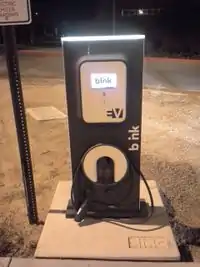 |
amenity=charging_station operator=Blink covered=no capacity=1 socket:type1_cable=1 socket:type1_cable:amperage=16 socket:type1_cable:voltage=120 bicycle=no motorcar=yes scooter=no hgv=yes wheelchair=yes fee=yes parking:fee=no payment:credit_cards=yes payment:debit_cards=yes ref=Unit #:4 |
The socket is attached to a coiled hose on the front of the charging station: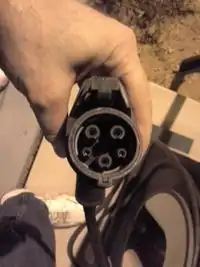 Like a regular US gas pump, the connector can be picked up before using your payment card. |
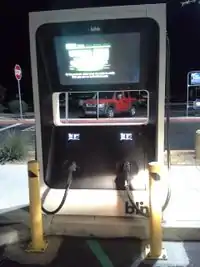 |
amenity=charging_station operator=Blink covered=no capacity=2 socket:chademo=2 socket:chademo:amperage=30 socket:chademo:voltage=240 bicycle=no motorcar=yes scooter=no hgv=yes wheelchair=yes fee=yes parking:fee=no payment:credit_cards=yes payment:debit_cards=yes ref=Unit #:1 |
The socket is attached to a high hanging hose on each side of the of the charging station: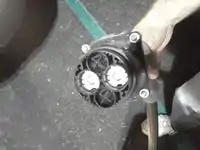 Like a regular US gas pump, the connector can be picked up before using your payment card. |
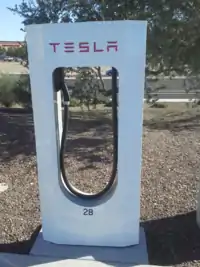 |
amenity=charging_station operator=Tesla, Inc. brand=Tesla Supercharger name=Buckeye Supercharger capacity=8 socket:tesla_supercharger=8 socket:tesla_supercharger:output=150 kW opening_hours=24/7 |
An example of US Tesla Supercharger (socket are different in Europe). The socket is attached to the center of station: Like a regular US gas pump, the connector can be picked up before using your payment card. This is still a work in progress based on 2776570644 2776570644. |
Symbols used in the vehicle charging station
 AC~ socket
 Chademo socket
 Chademo socket
 CCS socket
 CCS socket
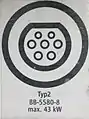 Type 2 socket
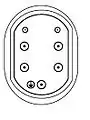 Type 3c socket
Gallery
 Charging station
 Charging station with Type 2/Mennekes plug and socket
 Charging station with Type 2/Mennekes plug
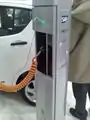 Charging station
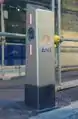 Newest charging station in Rome, Italy with Type 2/Mennekes and Type 3c/SCAME plug
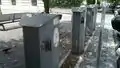 Older charging station in Rome, Italy with Type 3c/SCAME plug
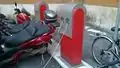 Other charging station in Rome, Italy with Type 3c/SCAME plug
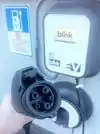 Charging station with Type 1/SAE J1772 connector at an office park in San Diego, California
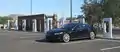 Tesla Super Charger at a Buckeye Arizona strip mall
See also
- amenity=fuel - a retail facility for refuelling cars.
- amenity=parking_space + parking_space=charging - an individual parking space reserved for charging electric vehicles.
- amenity=device_charging_station - for charging mobile phones via USB, etc.
- capacity:charging=* - Defines whether or not dedicated parking spaces with charging infrastructure for electric vehicles are available at car parking
- Proposed features/Charging station
- Proposal for charging places: If there are many charging stations at one single place, they can be combined into a single charging place using a Charging place relation.
Weblinks
There are some websites, where you can find charging stations.
Note that copying data from external databases is an import. Verifying license, documenting import and getting agreement from OSM community are mandatory.
- https://www.plugshare.com/
- https://e-tankstellen-finder.com/
- https://lemnet.org/en/map/
- https://www.ladestasjoner.no/ (Norway)
- https://www.goingelectric.de/
- https://map.openchargemap.io/ (on incompatible license, data must NOT be copied). Has own page at OpenChargeMap
- https://lade.info/map/ (Germany)
- https://www.e-laden.info/
- https://www.oplaadpunten.nl/
- https://www.fietsoplaadpunten.nl/
- https://afdc.energy.gov/fuels/electricity_locations.html#/find/nearest?fuel=ELEC&ev_levels=all (U.S. and Canada, govt. source)