Proposed features/Extended playground equipment
| Extended playground equipment | |
|---|---|
| Proposal status: | Draft (under way) |
| Proposed by: | Supaplex030, tordans, Ygramul |
| Tagging: | playground=* |
| Applies to: |  , ,  , ,  |
| Definition: | Add some more device values for playground tagging and give examples of detailed playground mapping |
| Draft started: | 2022-08-02 |
Proposal
This proposal intends to add more values to the list of documented playground devices and to extend the playground wiki page with some examples and guidelines for detailed playground mapping.
Rationale
There is already an established list of playground devices that can be mapped with the key "A" as individual objects within a playground. This allows precise evaluations of the features and quality of playgrounds or renderings of detailed maps and plans.
However, there is a great variety of playground equipment that cannot always be matched with the existing values. We are a group of mappers who have done a lot of playground mapping over the past few years and have come across a number of playground equipment that we miss. The TagInfo listing shows that other mappers seem to feel the same, so there has always been a need to get creative to come up with new tags. This has led to a large number of parallel, rarely used, undocumented and therefore hardly interpretable tags. We would like to close this gap and make recommendations on how such equipment should be tagged.
Playground equipment comes in almost every imaginable shape, design and function. It will never be possible to map every single one of them exactly. However, it is mostly possible to match even unusual, special devices into a certain "class" of equipment, e.g. balancing, climbing or water equipment. For this purpose, this proposal provides some general class values as a fallback in order to be able to map and evaluate such special devices in an interpretable way.
Tagging
ToDo More compact table/format?
List of new device values
| Key | Value | Element | Comment | Photo | TagInfo |
|---|---|---|---|---|---|
Some general new devices | |||||
| playground | belt_bridge | |
A tensioned, flat (mostly rubber) band to bounce on. |
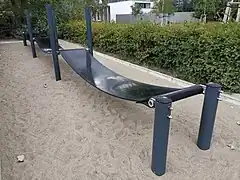 belt_bridge 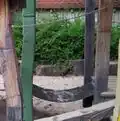 belt_bridge |
|
| playground | spring_board | |
A board or plane to stand on that is attached to the ground by springs and thus wobbles when standing/moving on it. Can sometimes also be equipped with holding bars to allow to "surf" on it. |
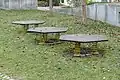 spring_board  spring_board |
|
| playground | hamster_wheel | |
A large spinning tube to go inside and twist arround, similar to a hamster's wheel. | 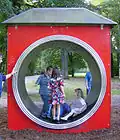 hamster_wheel |
|
| playground | ride | |
A fixed installation to sit on. | 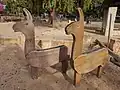 ride |
|
| playground | track | |
A path on a playground that is intended and equipped as a race track (e.g. by markings, obstacles or objects such as "petrol stations"). | 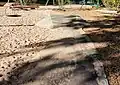 track |
|
| playground | musical_instrument | |
A musical instrument or device for making music and sounds. musical_instrument=* could be used to further specify the type of instrument. | 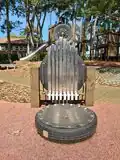 musical_instrument |
|
| playground | megaphone | |
A tube device to shout through (not to be confused with a playground=speaking_tube, where two tubes are connected to communicate with each other). | 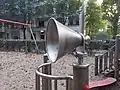 megaphone |
|
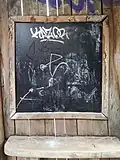
| playground | blackboard | |
A board to draw on with chalk or something similar.
"blackboard" would be the more common BrE term. --Polarbear w (talk) 22:34, 22 October 2022 (UTC)
|
 blackboard |
|
| playground | table | |
A play table. Typically not sized for adults to sit at. May include seats or benches and can thus share similar tags as picnic tables. | 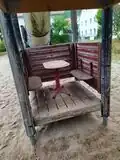 table |
|
| playground | seat | |
A single seat or bench for children. Typically not sized for adults to sit at. Often part of play houses or similar. | ||
| playground | hammock | |
A hammock, i.e. a spanned/tensioned surface to lie on. | 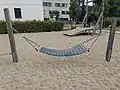 hammock |
|
| playground | artwork | |
A work of art/artful object as an element of playground decoration. If it has a significant art relevance, consider also adding tourism=artwork. | 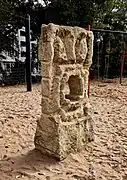 artwork |
|
Devices as parts of playground structures | |||||
| playground | steps | |
A stairway to get onto a platform or structure. | 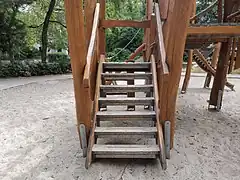 steps |
|
| playground | ladder | |
A ladder to climb onto a platform or structure. | 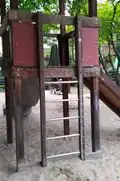 ladder |
|
| playground | ropebridge | |
A simple suspension bridge whose deck is suspended merely by cables or similar attached at the ends of the bridge and therefore wobbles or swings when moving on it. This value is an easy way to distinguish suspended/wobbling bridges from fixed/solid bridges without requiring knowledge about bridge construction. However, consider adding bridge:structure=* or cable_number=* if you can identify them to specify this more precisely. | 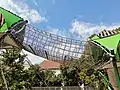 ropebridge |
|
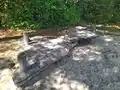
| playground | platform | |
A raised platform. May be part of or similar to a structure in that bridges or other equipment may be attached. Unlike structures, platforms have neither roofs, walls nor handholds around them. They may appear as part of structures, though, to micromap individual levels with their heights.
|
 platform 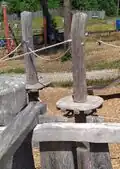 platform |
|
Swing devices | |||||
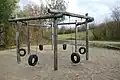
| playground | tire_swing | |
... Reifenschaukel. Besser: playground=swing mit Subtags? ([playground:]swing=tire/basket...). |
 tire_swing |
|
| playground | rope_swing | |
A swing element (usually a big rope) attached with chains or cables, on which usually several children can swing together at the same time. | 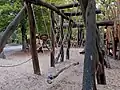 rope_swing |
|
Balance devices | |||||
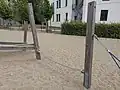
| playground | balance_rope | |
|
 balance_rope 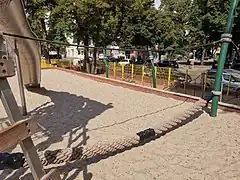 balance_rope 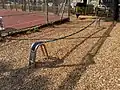 balance_rope |
|
| playground | slackline | |
A slackline, i.e. a suspended flat webbing/band/belt/strap that is tensioned between two anchors. |  slackline |
|
| playground | stepping_stone | |
Shifted stones or blocks with a distance between each other, for hopping or stepping from one to the next. See also fitness_station=stepping_stone, if the stepping stones are part of a leisure=fitness_station. | _062_-_Lenape_Playground.jpg.webp) stepping_stone |
|
| playground | stepping_post | |
Shifted posts or poles with stepping elements with a distance between each other, for hopping or stepping from one to the next. | 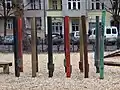 stepping_post 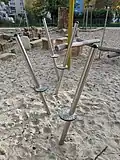 stepping_post |
|
Climbing devices | |||||
| playground | climbing_slope | |
A sloped climbing plane, often with handholds or tethers and often part of a structure to reach a higher level.
|
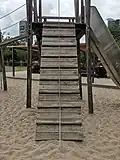 climbing_slope |
|
| playground | climbing_pole | |
|
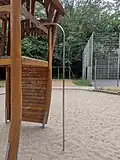 climbing_pole |
|
| playground | monkey_bars | |
Horizontal bars or hoops above head height to hang from by one's hands and move over hand over hand. For monkey bars that are part of a leisure=fitness_station, see fitness_station=horizontal_ladder. | 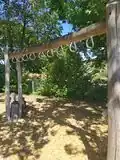 monkey_bars |
|
| playground | parallel_bars | |
Two or more bars side by side. In a playground setting often slanted. For parallel bars that are part of a leisure=fitness_station, see fitness_station=parallel_bars. For vertical bars, playground=climbing_pole may be more appropriate. | 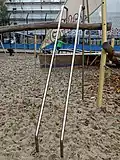 parallel_bars |
|
Rotating devices | |||||
| playground | spinner | |
A rotating device that, in contrast to a playground=roundabout, is very small, mostly only a small footboard or seat on a stick for one child. | 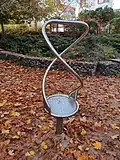 spinner |
|
| playground | spinning_disc | |
A simple rotating disc. In contrast to a playground=roundabout, there are no add-ons to sit or hold on to. | 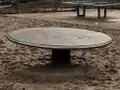 spinning_disc |
|
Sand play devices | |||||
| playground | sand_chute | |
A sloped tube or channel to transport sand by gravity from a higher to a lower place. | 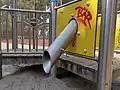 sand_chute |
|
| playground | sand_sieve | |
A sieve, allowing to separate fine-grained sand from gravel (in a playground setting typically not finer separated than that). | 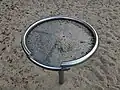 sand_sieve |
|
| playground | sand_wheel | |
A small wheel that turns when sand falls onto it. Often combined with a chute directly above. | 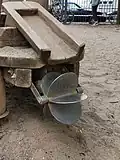 sand_wheel |
|
| playground | sand_seesaw | |
A channel or board on a pivot that can either route sand in two different directions, or allows to dump all accumulated sand in a chute-like manner when pivoted (when initially horizontal). | 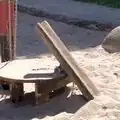 sand_seesaw |
|
| playground | sand_pulley | |
A small bucket or similar device holding sand (also common are sections of tire) that can be moved to another place. Typically either horizontally or vertically; may be mounted on a swivel to give a little more movement range. Often part of structures where it then allows to transport sand to other sand play devices mounted on the structure. | 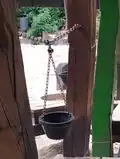 sand_pulley |
|
| playground | sand_table | |
A board or table primarily intended for playing with sand. Often equipped with other sand toys such as a sieve. | 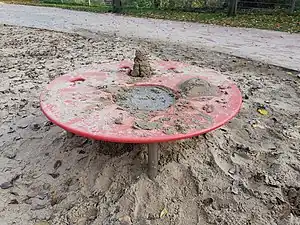 sand_table |
|
| playground | excavator | |
A small play excavator, allowing to move sand (or that rounded fine gravel) around a bit. Always fixed in place. Usually unpowered as just a series of metal linkages controlling the excavator bucket. For bigger, usually fenced off excavators with a fee=yes consider using attraction=*. | 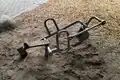 excavator |
|
Water devices | |||||
| playground | pump | |
A water source to play with. Often this is an actual pump with handle, but may also have different forms, such as a water wheel lifting water from a reservoir, or a button that can be pressed for water to flow for a limited time. For water flowing continuously or without interaction, use sprinkler instead. |
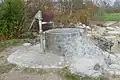 pump |
|
| playground | water_channel | |
An inclined channel for water to flow towards other devices. Typically raised so that multiple channels in series route water from a pump to ground level. For water channels in the ground, resembling natural streams, use water_stream instead. | 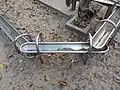 water_channel |
|
| playground | water_stream | |
A meandering stream of water resembling a natural water stream and looking a tad less artificial. Often enclosed in an artificial bed of stones. | 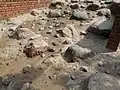 water_stream |
|
| playground | water_seesaw | |
A seesaw-like water channel for either diverting water to two different places, or for automatically tilting and emptying when full. | 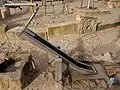 water_seesaw |
|
| playground | water_basin | |
A pool where water gathers, inviting either to run around in or combine it with sand to mud (also known as "mud table"). May have exits to other channels or even a drain in the bottom (sometimes with a plug). |
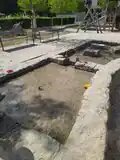 water_basin 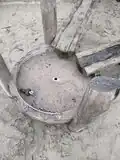 basin with drain and plug |
|
| playground | water_barrier | |
A removable barrier for water that inhibits flow towards other devices, often via an adjacent channel. | 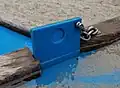 water_barrier |
|
| playground | archimedes_screw | |
A screw-like device for lifting water from a lower to a higher elevation. | 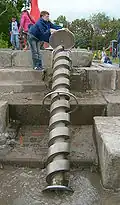 archimedes_screw |
|
| playground | water_wheel | |
A wheel with small buckets or paddles that rotates when water flows into and over it. | 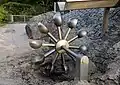 water_wheel |
|
| playground | water_cannon | |
... | 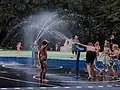 water_cannon |
|
| playground | sprinkler | |
A continuously-running jet of water that is directed upward. |  sprinkler |
|
Topographical devices | |||||
| playground | mound | |
Artificial hills, elevations, waves etc. intentionally designed for play. Sometimes devices like slides or tunnel tubes are placed on or in them. | _069_-_Playground.jpg.webp) mound |
|
| playground | dome | |
A half-sphere to play or slide on. | 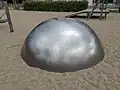 dome |
|
Fallback values for devices, that clearly fit into one equipment category, but do not fit any of the existing subcategories | |||||
| playground | balance | |
A special device to balance on. | 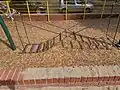 balance |
|
| playground | climbing | |
A special device to climb on. | ||
| playground | rotator | |
A special rotating device. | ||
| playground | water | |
A special water device. | ||
| playground | sand | |
A special sand play device. | ||
Guidelines for detailed playground mapping
Node, way or area?
As usual with OSM, this is often a question of what makes sense in the first place and also whether features are amenable to being mapped in a certain way. In experiments over the last few months a few common themes emerged:
1. Mapping equipment as nodes for quick mapping what is available remains a good option to quickly add equipment where not yet present. Data consumers such as Babykarte don't require exact locations or shapes. 2. For adding further detail, some features are naturally area-shaped, such as sandpits, structures and lend themselves to being represented by an area. Especially for structures this also enables to add devices attached to that structure in a natural manner. 3. Especially from structures a number of linear features may branch off, such as bridges or slides. Those typically have one end node on the structure outline. A number of point-like features like ladders, sand play equipment like chutes, etc. also are usually tagged as nodes on the structure outline. Other linear features like zip lines, horizontal bars or anything else that's traversed in a particular direction, like balance devices, monkey bars, etc. can often also be mapped as ways.
ToDo
Additional tags
Many devices can be tagged with further detailed information, e.g. on their size, material, accessibility or user group. This allows detailed evaluation options such as searching for playground equipment for children of a certain age or with disabilities. Besides, wouldn't it be interesting to be able to find the highest, longest and steepest slide in the city with OSM?
For this, it is worth adding some extra tags that are already documented:
- material=* of the equipment (e.g. wood, metal or plastic on constructions or chain and rope on climbing devices),
- height=* of equipment such as slides or climbing frames,
- incline=* of slides or climbing slopes,
- capacity=* on swings, seesaws etc. to indicate the number of people who can use a device at the same time,
- handrail=* on equipment that provides something to hold on to by hand,
- as well as other tags that can be useful on individual devices (e.g. covered=* on tunnel slides, step_count=* on stairs and ladders).
Moreover, we propose the use of the following tags for specific statements:
- seating=yes/no or standing=yes/no to indicate whether a device can be used standing or sitting (see examples).
Tagging of structures and bridges
ToDo
- Distinction between different bridges (fixed vs. swing/rope bridges, see already in the wiki).
- Usage of platform, tagging of levels etc.
- Example sketch of a detailed mapped structure with platforms, bridges, stairs, slides etc.
Tagging for specific age groups
ToDo
- baby=* vs. provided_for:*=*
Further tagging possibilities
- Suggestions for tagging information on accessibility are already documented in the wiki.
Examples for device detail mapping
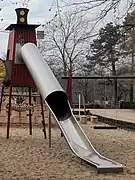
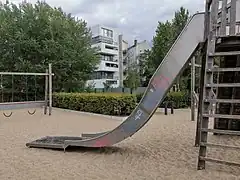
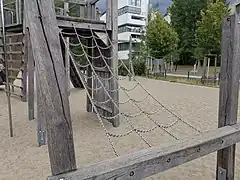
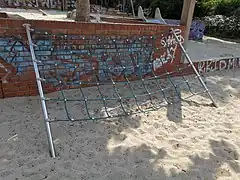
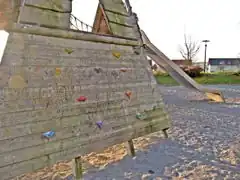
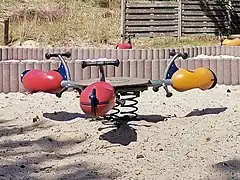
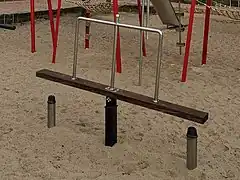
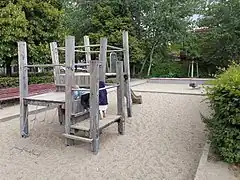
 playground=spinner
seating=yes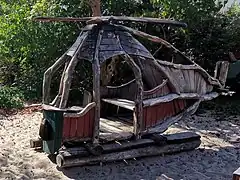
Features/Pages affected
- The list of playground=* equipment needs an update: Add the new values, regroup them in some more device categories and add more/detailled examples and guidelines.
Comments
Please comment on the discussion page.
Frequently used values that are not yet documented in the playground list
| Value | TagInfo | Image(s) | Notes |
|---|---|---|---|
| map | 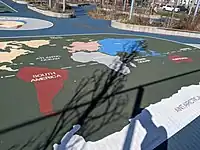 map |
playground=map has a wiki page with description and examples, but value is not in the list. | |
| four_square | _100.jpg.webp) four_square |
Ground markings (similar to playground=hopscotch) for Four Square game (a team sport played among two teams with two players each on a square court divided into four quadrants). | |
| tetherball | Wikipedia: Tetherball. Mostly/better mapped leisure=pitch + sport=tetherball. | ||
| outside_public_arranged | Special tagging from Nairobi | ||
| multi_play | Unclear. Some instances where Mapillary images exist nearby suggest that this may refer to structure and could be detail-mapped with more specific equipment. Example | ||
| playset | Might refer to playground=structure. Example | ||
| play_structure | Most likely a synonym for playground=structure. | ||
| swings | Use playground=swing + capacity=* instead. | ||
| swingset | Use playground=swing + capacity=* instead. | ||
| digger | Use playground=excavator instead. | ||
| forest | ? Use landuse=*/landcover=* instead. | ||
| spinner | Probably another generic term for the various rotating devices. | ||
| basketball_backboard | Better use leisure=pitch + sport=basketball/sport=streetball (perhaps with hoops=1). | ||
| table_tennis (and variations) | Better use leisure=pitch + sport=table_tennis. | ||
| tunnel | See playground=tunnel_tube. | ||
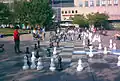
| chess_table | .jpg.webp) |
Better use leisure=pitch + sport=chess.
| |
| marble_run | 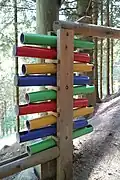 marble_run |
A rolling ball sculpture where a ball (often a marble) moves through a predefined course just by gravity. | |
| parallel_bars | 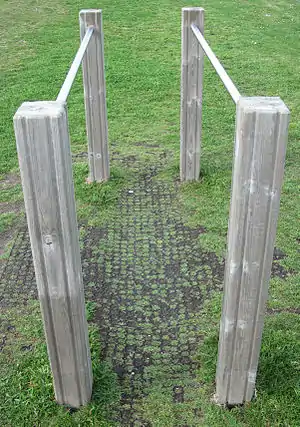 |
Consider using fitness_station=parallel_bars if it's part of a leisure=fitness_station. | |
| tic-tac-toe | playground=activitypanel is documented for this, but a more precise specification might be good. | ||
| water_feature | Possibly replace with one of the more specific water devices if possible. | ||
To be discussed
Some equipment may still not have an immediately obvious classification, even with the improvements we're thinking of. We can collect them here and discuss whether something sensible can come out of that or we need more tags.
| Image(s) | Notes |
|---|---|
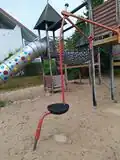 |
A large rotating pad to stand or sit on. Perhaps similar to
|
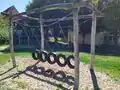 |
Something like a hybrid between playground=rope_swing and playground=tire_swing. However, my bet would be more on playground=rope_swing here, just implemented with tires, since the mechanism of suspension and thus how it can move is very similar, albeit probably with more inertia. --Ygramul (talk) 07:24, 3 September 2022 (UTC)
|
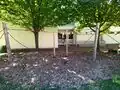 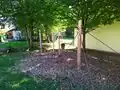 |
Might be playground=balance or something like playground=swing + swing=pole (or any other way we want to categorize standing swings). --Ygramul (talk) 07:24, 3 September 2022 (UTC) |
- Das ist etwa das was ich oben mit
rotatormeine (rotator_stickin meinem Verständnis, wenn es nichts zum draufstellen gibt). Aber alle rotierenden Dinge sollten wir am besten nochmal genauer durchdenken ;) --Supaplex030 (talk) 15:35, 17 August 2022 (UTC)- Nochmal drüber nachgedacht: Mmn fehlen nur
rotator_stickspinner und spinning_disc (oben ergänzt). rotator könnte man als Fallback für Edge Cases dokumentieren, wenn wirklich nichts anderes passt. Die Geräte aus dem "Stehkreisel"-Link scheinen mir jeweils zu roundabout,rotator_stickspinner oder spinning_disc zu passen, je nach Größe und Ausstattung.--Supaplex030 (talk) 12:53, 11 October 2022 (UTC)
- Nochmal drüber nachgedacht: Mmn fehlen nur
- Das ist etwa das was ich oben mit
- Ygramul: Ein "Sitzkreisel" Beispiel. Gibt's in verschiedenen Formen. Aber ich glaube, sie sind alle leicht geneigt, so daß die normale Gewichtsverlagerung des Kreiselnden die Drehung beinahe automatisch aufrecht erhält.
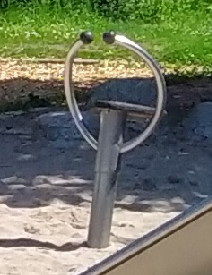
- Weiteres Bild hier - ähnlich wie ein
rotator_stickspinner, aber nicht zum Stehen? --Supaplex030 (talk) 22:43, 18 August 2022 (UTC) - Hier noch eine Variante, die vermutlich sowohl stehend als auch sitzend verwendbar ist. --Ygramul (talk) 08:02, 20 August 2022 (UTC)
- Würde das nicht alles etwa zu
rotator_stickspinner passen? Man könnte (ähnlich wie bei Toiletten ;) über ein "seated"-Tag nachdenken, um auszudrücken, dass es eine Sitzmöglichkeit gibt. Ich finde seating, standing etc. für sowas ganz gut.--Supaplex030 (talk) 12:53, 11 October 2022 (UTC)
- Würde das nicht alles etwa zu
- Weiteres Bild hier - ähnlich wie ein

- Shall we make a recommendation on how to map surfaces with wood chips or gravel as "playground surface"? I always use landcover=woodchips etc., area=* + surface=* combinations are also very common... But maybe this is a bit out of scope and should be discussed separately. --Supaplex030 (talk) 08:23, 23 October 2022 (UTC)
- That's perhaps for a different proposal. And perhaps that would be larger in scope than just playgrounds, but then we're probably back to landcover which didn't exactly excite people enough to vote ... --Ygramul (talk) 22:22, 25 October 2022 (UTC)
- Flat water basins seem to often be called mud tables. And admittedly, they certainly invite to throw sand in as well (especially when close to the ground). Would that be a useful additional tag for water equipment? If so, where does basin end and mud_table start? --Ygramul (talk) 22:22, 25 October 2022 (UTC)
- I think I would map it as "water_basin", because at least in my area basins almost always become muddy over time ;) --Supaplex030 (talk) 19:51, 27 October 2022 (UTC)
- Sand play equipment is often integrated into tables that are called "sand board" or "sand table" by manufacturers. Not exactly a table to sit on (unlike table), but a platform that's more for playing than standing on (unlike platform), which may support other devices, such as a funnel or a sieve. --Ygramul (talk) 22:22, 25 October 2022 (UTC)
- Yes, I see them so regularly that I have already thought of sand_table. I would add it as well. On the right there is a first picture, but I think there are better examples (e.g. somewhat larger, "board"-like ones). --Supaplex030 (talk) 19:51, 27 October 2022 (UTC)
- Seen once so far, might be worth documenting: A wall with a large window and counter that allows children to play shop. I think a play house on one playground here has something similar in one wall. Definitely not a normal window, but rather a counter where sand cakes may be "sold". playground=shop exists once. already. No idea whether it's intended for this, though. --Ygramul (talk) 22:22, 25 October 2022 (UTC)
Further tagging ideas
- More/better documentation about how to map certain things as non-nodes. Nodes are probably always centered on the object. For way-like objects (balance beam, slide, zipway, etc.) ways are fairly self-evident. However, I've been mapping swings typically as ways that follow the bar on which the swings are mounted, which then is perpendicular to the swinging direction. Perhaps that's okay, but perhaps we can give more guidance for specific examples. A simple sentence like the common »how to map« instruction is probably enough. Ygramul (talk) 06:14, 18 August 2022 (UTC)
- Detailed mapping of structures can be somewhat complicated, although one could probably take a few pointers from mapping buildings (both indoor and outdoor). This could include both things like parts, roofs, levels, height/min_height, equipment inside the structure (like ladders leading upwards, or table and benches in the lowest floor, etc.). Ygramul (talk) 21:48, 18 August 2022 (UTC)
- Structures may not be as regular as normal buildings and levels may not be evenly distributed. Adding things like platforms inside structures to also keep the height may work. However, would we want something like structure:part=* for those things and still tag them additionally as playground=*? Probably better to not complicate data usage for typical use cases. --Ygramul (talk) 05:44, 23 August 2022 (UTC)
- I have assumed so far that the belonging of a device to a structure results geometrically if it is mapped within or on the line of a structure. But I think this 3D mapping topic needs its own thinking, preferably with a simple example (we need Simple 3D Playgrounds ;) --Supaplex030 (talk) 08:17, 24 August 2022 (UTC)
- Structures may not be as regular as normal buildings and levels may not be evenly distributed. Adding things like platforms inside structures to also keep the height may work. However, would we want something like structure:part=* for those things and still tag them additionally as playground=*? Probably better to not complicate data usage for typical use cases. --Ygramul (talk) 05:44, 23 August 2022 (UTC)
- We should probably suggest a lot more detail tags, even for established values. For lots of things height or width can make sense. Slides are sometimes already tagged with incline. Perhaps there are a bunch of interesting characteristics for certain equipment that makes sense to at least be able to tag. Many mappers don't invent tags if the Wiki doesn't suggest them and if we get a good sense of the variations for certain equipment here, that may simplify deciding what details would be warranted. Ygramul (talk) 21:48, 18 August 2022 (UTC)
- height is often a good one for various things: Total height of a slide, height of a balancing rope (although would we want the highest or the lowest height for that? One playground here has variance of 50 cm for a balancing rope between highest and lowest point), height of platforms, height of structures, hanging height for monkey bars (probably most sensible to use the height at which the hands would grab), height of horizontal bars, height of a seesaw (may inform suitability for different ages), ... --Ygramul (talk) 05:44, 23 August 2022 (UTC)
- I think I've always tagged a "mean" height so far, but can't remember any equipment where the height varies a lot. Vorteil: If you define the height as "mean height" and also use "incline" (and get the length from the geometry or a tag), you can calculate the maximum and minimum height. --Supaplex030 (talk) 08:17, 24 August 2022 (UTC)
- Mean height sounds good for things like hanging bridges or balancing ropes, but terribly unintuitive for slides, for example. Also height commonly refers to the elevation of the highest point of a feature, so perhaps that's still the best interpretation. The combination of height (as maximum height) with incline would also allow to calculate the minimum height (although that one could be tagged as well, if desired, e.g. for slopes that don't start at ground level). --Ygramul (talk) 10:42, 24 August 2022 (UTC)
- You're absolutely right - on a slide, of course, I also mean the highest point. Then let's define that as the "highest" point later. --Supaplex030 (talk) 11:07, 24 August 2022 (UTC)
- Mean height sounds good for things like hanging bridges or balancing ropes, but terribly unintuitive for slides, for example. Also height commonly refers to the elevation of the highest point of a feature, so perhaps that's still the best interpretation. The combination of height (as maximum height) with incline would also allow to calculate the minimum height (although that one could be tagged as well, if desired, e.g. for slopes that don't start at ground level). --Ygramul (talk) 10:42, 24 August 2022 (UTC)
- I think I've always tagged a "mean" height so far, but can't remember any equipment where the height varies a lot. Vorteil: If you define the height as "mean height" and also use "incline" (and get the length from the geometry or a tag), you can calculate the maximum and minimum height. --Supaplex030 (talk) 08:17, 24 August 2022 (UTC)
- height is often a good one for various things: Total height of a slide, height of a balancing rope (although would we want the highest or the lowest height for that? One playground here has variance of 50 cm for a balancing rope between highest and lowest point), height of platforms, height of structures, hanging height for monkey bars (probably most sensible to use the height at which the hands would grab), height of horizontal bars, height of a seesaw (may inform suitability for different ages), ... --Ygramul (talk) 05:44, 23 August 2022 (UTC)
Sub tagging variants
- In general I'd probably like to have a bunch of more generic tags that broadly describe the purpose of the equipment (slide, spinning / rotating, bridge, climbing, balance, water, sand, ...) and use additional detail tags (perhaps using the value as key, as is common in other places of OSM tagging already) to describe the actual implementation. This may make it easier to “invent” new equipment names since we don't need a canonical top-level name that makes sense – only one for the detail tag. So instead of having climbingframe, climbingwall, ladder, ... those could all just be playground=climbing + climbing=*. This would invalidate/deprecate some names currently in common use, so open for discussion here. In the vein of this proposal I've already added playground=sand as a sort of general category to the table above. playground=water could similarly be extended to allow for tagging specific water-based equipment like pumps, (interactive) barriers, intended paths for the water, drains, etc. Ygramul (talk) 06:14, 18 August 2022 (UTC)
- I agree, even though this implies a significant impact on the existing playground scheme. I wonder if it's a good idea to use the playground terms directly as secondary keys, or if the playground:* notation could be used. Example: playground=water + water=channel - the latter is already common in other contexts and could possibly lead to conflicts somewhere. On the other hand, homonymous keys are a common phenomenon in OSM. The list of Homonymous keys would definitely become a bit longer ;)
- Alternatively, one could use playground:water=channel instead, for example (but this too is a homonymous use/changes the meaning of existing tags, since this key is already part of the playground scheme with values yes/no). --Supaplex030 (talk) 22:20, 22 August 2022 (UTC)
- To not get clashes (and I wouldn't want to hijack water=* for playgrounds, as I think the existing use is far more important than playground micromapping) one could also rename playground=water to playground=water_play and then use water_play as secondary key. Might go nicely with sand_play and water is not used that often so changing it for a more consistent scheme might not hurt that much at this point, I think. But also a different secondary key would probably be fine. There's a few schemes with foo:type=* already as well (hydrants, I think, have a lot of those). --Ygramul (talk) 05:44, 23 August 2022 (UTC)
- So, if I see correctly, we have the following suggestions so far (I use playground=water as an example):
- 1) The direct use of the playground value as a subkey (e.g. playground=water + water=channel - common in OSM, but there are homonymous interferences with other uses).
- 2) Add a
playground:*prefix to the subkey (playground=water + playground:water=channel - homonymous confusion would no longer exist, but the playground:*=* keys would be redefined). - 3) We make sure that all subkeys do not conflict with documented keys (e.g. playground=water_play + water_play=channel, but also need changes in other cases like
bridge). - 4) We use a new key like playground=water + water:type=channel (already in use, but deprecated e.g. in the context of natural=water).
- Did I forget something? Are there other or better variants? I think with a list of suggestions like this, I could start a discussion on the tagging mailing list to get a first community opinion... --Supaplex030 (talk) 08:17, 24 August 2022 (UTC)
- I think that's about it, yeah. Well, there's probably an option 5, although I don't find it that desirable, which would eschew broad category tags for a lot more playground=* values which are then no longer explicitly linked as being water-based. The preferred direction there probably comes down to what we expect data consumers to do with that data. --Ygramul (talk) 10:42, 24 August 2022 (UTC)
- Yes, this 5th option exists too, of course. I ignored that as I see that option on a different decision level: So question 1 is: 1A) individual tags for each type of equipment as before or 1B) main tags and subtags for "classes" of similar playground equipment? If 1B, then question 2 is: How is the subtag "syntax"? (If 1A, we could think about a standard scheme like
water:cannon,water:archimedes_screw,swing:tire...). --Supaplex030 (talk) 11:07, 24 August 2022 (UTC)- I more and more like the variant with a tag prefix:
climbing:slope,climbing:pole,water:basin,water:sprinkler,sand:chute,sand:sieve... Even if it sometimes reads a bit strange when the sub-term is in front in spoken language (bridge:belt,swing:tire...). If you are not sure what fits, or in edge cases, just use the generic term (e.g.balanceinstead ofbalance:beam/balance:rope/what ever). Also for rendering purposes, automated equipment evaluations etc. this values can be interpreted easily. --Supaplex030 (talk) 11:37, 13 September 2022 (UTC)- For documentation: We discussed this topic in the forum and the opinion was mostly that the ":" notation has no advantages. --Supaplex030 (talk) 09:58, 21 October 2022 (UTC)
- I more and more like the variant with a tag prefix:
- Yes, this 5th option exists too, of course. I ignored that as I see that option on a different decision level: So question 1 is: 1A) individual tags for each type of equipment as before or 1B) main tags and subtags for "classes" of similar playground equipment? If 1B, then question 2 is: How is the subtag "syntax"? (If 1A, we could think about a standard scheme like
- I think that's about it, yeah. Well, there's probably an option 5, although I don't find it that desirable, which would eschew broad category tags for a lot more playground=* values which are then no longer explicitly linked as being water-based. The preferred direction there probably comes down to what we expect data consumers to do with that data. --Ygramul (talk) 10:42, 24 August 2022 (UTC)
- To not get clashes (and I wouldn't want to hijack water=* for playgrounds, as I think the existing use is far more important than playground micromapping) one could also rename playground=water to playground=water_play and then use water_play as secondary key. Might go nicely with sand_play and water is not used that often so changing it for a more consistent scheme might not hurt that much at this point, I think. But also a different secondary key would probably be fine. There's a few schemes with foo:type=* already as well (hydrants, I think, have a lot of those). --Ygramul (talk) 05:44, 23 August 2022 (UTC)
Some other notes of the proposal authors
Translation-Sammlung (DE)
- belt_bridge: "Hüpfbandbrücke"
- spinner: "Drehteller"
- spinning_disc: "Drehscheibe"
- rope_swing: "Raupenschwinger"
- stepping_posts: "Balancierstelze"
- tunnel_tube: "Kriechtunnel"
- climbingframe: "Kletterspinne" oder "Netzaufstieg"
Gute Recherche-Quellen
- Die Website http://www.seibel-spielgeraete.de/katalog.php ist eine gute Quelle für Namen mit Fotos.
- Die Website https://shop.eibe.de/Spielgeraete/ ist eine weitere Seite für Beispiele zu Spielgeräten mit Bildern
- Die Website http://www.stilum.com/en/playground-equipment/ ist eine gute Quelle für Namen in Englisch.
- Die Website http://www.med-etc.com/soz/kind/sp/spielplatz-elemente02-5-bis-11-jahre04-rondelle-poller-trampolin-spielschlange-klettern.html hat eine sehr eigenartige Struktur, aber hat viele Fotos und "Beschreibungsvorschläge"
- Die Webseite https://www.niclimbingframes.com/climbing-frames hat einige Namen für Bestandteile von playground=structure (dort offenbar als climbing frame bezeichnet)
- Die Webseite https://www.flightsoffantasy.co.uk/product-portfolio/traditional-play-apparatus/ hat einige gute Begriffsvorschläge für Geräten, die hier neu hinzukommen
List and Numbers
https://docs.google.com/spreadsheets/d/1KubPCL1adcmCRSXBNZ4IRqyCVQLSECSCeVezkqfHWyw/edit#gid=0 has a list of all playground=* in Germany with some pivot-Tables to groups the results. We can use it to find elements that are mapped with description (or fixme/todo) which is a strong indicator that a more precise value is missing.