Power networks/Canada/Alberta
This page is dedicated for the mapping of power-related infrastructure in Alberta.
Background
The Alberta power grid uses voltages different from the surrounding provinces and U.S. states. The province's generation and transmission sectors remained a monopoly under TransAlta until the deregulation in 1998, making Alberta the first provinces in Canada to deregulate the power industry. The transmission sector is dominated by AltaLink (a spinoff corporation of TransAlta, serving most of the province), and ATCO Electric (which operates transmission facilities to the northwest and northeast), while the distribution sector is held by different operators, including investor utilities (e.g. FortisAlberta, ATCO Electric), municipal utilities (e.g. EPCOR, ENMAX) and rural electrification cooperatives (commonly called Rural Electrification Associations or REAs).
The Alberta transmission grid is centred on the Edmonton and Calgary regions, and bulk power transmission between the regions is provided by two high-voltage direct current (HVDC) power lines, the Eastern Alberta Transmission Line (EATL) and Western Alberta Transmission Line (WATL). The grid is connected to the surrounding provinces and states (except the Northwest Territories) through 500 kV interconnections or 230/240 kV autotransformers. The British Columbia connection is provided by a 500 kV line and two 138 kV lines (fed by BC Hydro’s 230 kV network) through southern Alberta operated by Altalink while a third 138 kV in Northern Alberta is operated by ATCO Electric. Alberta's grid connects with the United States through the Montana-Alberta Transmission Line (MATL), energized at 230 kV and upstepped to Alberta 240 kV through an autotransformer substation northeast of Lethbridge. The Alberta grid connects with SaskPower's (Saskatchewan) grid through a 42 kV back-to-back converter station northeast of Medicine Hat. Alberta is part of the Western Interconnection of the wider Northern American grid.
Operators
Incomplete list.
See also w:List of Canadian electric utilities#Alberta for a complete list, but note some of the listed utilities may no longer be existing.
- AltaLink - most transmission lines
- ATCO Electric - some transmission lines, (EATL, Fort McMurray West), and distribution in some parts of the province (e.g. Fort McMurray and area, Grande Prairie, High Level)
- EQUS - rural electrification utility on areas of the Edmonton Capital Region not covered by FortisAlberta
- FortisAlberta - most non-municipal or cooperative-owned distribution networks
Municipally-owned utilities
Voltages
| Voltage | Network | Notes | Appearance | Example |
|---|---|---|---|---|
| 500 kV | Transmission | Used in bulk power transmission. Lines primarily connect with large power plants in the Edmonton Capital Region and the HVDC connections with the Calgary Region. Also used on the interconnection with the BC power grid via the Crowsnest Pass. | Lattice towers (with tubular steel towers used on parts of the Heartland Transmission Line along Anthony Henday Drive in Sherwood Park). Usually triple-bundle, single-circuit lines (Heartland Transmission Line: double-circuit).
HVDC lines (WATL and EATL) also use this voltage |
.jpg.webp) |
| 240 kV | Primary transmission voltage. Lines of this voltage reach most parts of the province, except the Rockies and Peace River Country. | Steel lattice towers or H-frame structures. Some lines in urban areas use steel poles because of aesthetic concerns | 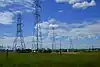 | |
| 138/144 kV | Transmission and subtransmission | Common subtransmission voltage, mostly used to feed 24.94 kV systems throughout the province. In the Rockies and Peace River Country, it is also used for transmission. 138 kV used by ENMAX and Altalink, 144 kV used by ATCO Electric. | Tall wooden poles with 3 cables, sometimes with a feeder. Some newer lines or line upgrades use steel poles, especially in urban areas. Some lines double or triple-circuit. |  |
| 69 kV/72 kV | Subtransmission | Feeds from the 240 or 144/138 kV grids. The 12.47 kV network connects to the 69 kV/72 kV system. Mostly scattered networks found in Edmonton, northern Calgary and parts of rural Alberta. 69 kV is used by ENMAX and Altalink, 72kV used by ATCO Electric and EPCOR. | Taller poles or H-frames, with 3 cables. | |
| 14.4/24.94kV ("25 kV” | Distribution | Primary distribution voltage in the province, fed by the 138/144 kV system. | Ordinary sized poles in rural areas and back alleys, or underground cables. Multiple circuits may not be obvious from most aerial photography (possible exceptions being high-resolution airphoto by certain municipalities as hosted on Esri). 24.94 and 12.47 kV systems are generally looped, with many single-phase or three-phase branches and backup connections from other substations provided by open disconnector switches at the end of feeders. | |
| 7.2/12.47 kV | Used in the majority of the distribution system. | |||
| 120/240 V split-phase, 120/208 V three-phase, 347/600 V three-phase | Standard voltage for end customers. These voltages are generally supplied by a pole-mounted transformer (in rural area or back alleys) or pad-mount transformer (in cities). |
Tagging recommendations
- Lines from 120/240 V to 24.94 kV - power=minor_line
- Lines from 69 kV and above - power=line
- Steel or wood poles on transmission lines from 69/72 kV - power=pole (steel poles carrying a single circuit, and single wood poles with or without cross-arms. Only on 69/72 and 138/144 kV lines) or power=tower (H-frames, steel poles with double circuits on cross-arms)
- Lattice towers - power=tower
- Distribution line poles - power=pole (all single poles), power=tower (H-frames)