Power networks/Philippines
This page aims to coordinate the efforts of mapping electricity-related objects in the Philippines. It is intended to be a guide for mapping power lines from aerial imagery and on-the-ground observation.
The transmission network in the Philippines uses a mix of lattice towers and steel, concrete or wood poles, the latter common on power lines placed along road or railroad rights of way in urban areas and on lines where most of their portions have lower clearance between the ground, buildings, and vegetation and the line. Voltages used are:
- 115 kV: Used in parts of Ilocos for transmission. Generally used for sub-transmission (see below)
- 138 kV: Main transmission voltage in Visayas and Mindanao. Usually single-conductor, some double-bundle
- 230 kV: Main transmission voltage in Luzon, and bulk transmission voltage in Visayas and Mindanao. Now mostly using double-bundle conductor
- 500 kV: Bulk transmission voltage in Luzon, using quadruple-bundle conductors.
The number of transmission structures in the Philippines (towers and poles) are approximately 27,473 structures and number may be increased as more structures are constructed.
In between the transmission and distribution networks is the sub-transmission network, operating at either 69 kV or 115 kV. Lines are usually mounted on steel, concrete or wood poles, and feed onto distribution substations and large industrial customers.
Distribution networks operate 6.28, 7.97/13.8, 13.2/23 and 20/34.5 kV, but the most common is 7.97/13.8 kV. Lines usually have one to three conductors strung on poles, and usually has a neutral line; six or more wires usually occur on lines carrying multiple circuits from a substation. The distribution voltages are stepped down to 230 V single-phase for household consumption; commercial and light industrial users are generally supplied at 127/220 or 254/440 V three-phase.
Networks
The Philippine power grid is divided into a generation, transmission, sub-transmission, and distribution sector. The grid frequency is at 60 Hz, the same as with North America, Taiwan and west Japan, but different from most of Southeast Asia which uses 50 Hz.
Generation
Power produces and generates from a power plant which is called as power generation. There are many types of power plant which are hydroelectric, geothermal, coal, biomass power, wind power, diesel, natural gas, and nuclear. Most power plants are operated and owned by private companies, while some are local government-owned like the Bauang Diesel Power Plant and Philippine government-owned (through National Power Corporation (NAPOCOR/NPC)) such as the Ambuklao Dam and Hydroelectric Plant.
Power lines are connected to the transmission grid through their respective generation dedicated point to point lines. Generation point to point lines are power lines that connect from a power plant to the National Grid Corporation of the Philippines (NGCP) substation, can range from 69 kV to 500 kV, and their structures can use either poles or towers like the transmission grid. Prior to the transfer of operations, maintenance, and ownership of the power grid from NAPOCOR to National Transmission Corporation (TransCo) on March 1, 2003, NAPOCOR built these lines. Upon the transfer of the grid from NAPOCOR to TransCo, generation power lines that were built by NAPOCOR are now owned by TransCo since March 1, 2003 and operated and maintained by NGCP since January 15, 2009 like the power lines on the transmission grid. Some lines that were built after NAPOCOR took over the power grid to TransCo on March 2003 were built by power generation companies such as the Subic-MSPP Transmission Line, as stated in Section 9 of Electric Power Industry Reform Act (EPIRA) law or Republic Act 9136 where a generation company may construct and own or operate dedicated point-to-point limited transmission facilities that are consistent with the Transmission Development Plan (TDP) for the purpose of connecting to the transmission system, and are used solely by the generating facility, subject to prior authorization by the Energy Regulatory Commission (ERC).
Transmission
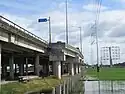
The transmission grid, also ranging from 69 kV to 500 kV like with the generation dedicated point to point lines, is divided into three grids, the Luzon Grid, the Visayas Grid, and the Mindanao Grid. Power lines in the transmission grid are lines that connect from one NGCP substation to another (i.e. Hermosa-Duhat-Balintawak transmission line, as shown on the right) or to a distribution company substation. Luzon Grid uses voltages of 69 kV, 115 kV, 230 kV, and 500 kV, while the Visayas and Mindanao grids use 69 kV, 138 kV, and 230 kV. The Luzon and Visayas grids are interconnected through the 350 kV DC HVDC Leyte-Luzon transmission line, while the Mindanao Grid remains isolated until the completion of a HVDC link from Cebu to Lanao del Norte. Off-grid islands with multiple power sources (local power plants and offshore power barges) have transmission systems operating at 69 kV. The transmission system and its related assets and facilities are operated and maintained by NGCP, and owned by the TransCo, a government-owned company spun off from NAPOCOR/NPC which used to operate, maintain, and own the Philippine power grid until March 1, 2003.
Sub-transmission
There are also sub-transmission grids, which operate with voltages of 69 kV and 115 kV. NGCP normally runs these grids in conjunction with the transmission system in most of the country, but in poorer areas, 69 kV lines still function as transmission lines, and in Ilocos, 115 kV is used for transmission. Power distributors and electric cooperatives also have their own sub-transmission systems, and many sub-transmission lines once operated and maintained by NGCP are being handed to those.
Distribution
The distribution networks are operated by a handful of both investor-owned and municipal power utilities companies, and hundreds of electric cooperatives, collectively called power distribution companies (PDCs) by the Department of Energy (DOE). Power lines in those networks generally operate at 7.97/13.8 kV or 20/34.5 kV, which is then downstepped to 230 V or 254/440 V for consumption.
Structure tagging, and lands and portions acquisition and designation
The power line structures are tagged with reference numbers (either simply a whole number (i.e. 1, 2, 3, 4, and so on), voltage level code, abbreviation of starting and ending point of a power line or power line segment which can either be enclosed in a parenthesis or not and structure number (i.e. (8LI1DUH-HER)179 which refers to relocated steel pole 230 of Hermosa-Duhat-Balintawak transmission line and pole 179 of Hermosa-Duhat segment of the said power line along North Luzon Expressway (NLEx) in San Simon, Pampanga), or abbreviation of a line and reference number of a structure (i.e. HB-1, HB-2, HB-3, and so on, referring to steel poles 1, 2, and 3 of Hermosa-Duhat-Balintawak line) and danger signs.
Since the 1990s, danger signs may also state the company who built the structures (including replacement structures), and acquired and designated lands for the transmission structures (including secondhand structures which are structures that were originally used on another place before their relocation and having their original reference number placed either in the front or back of the structure before a new reference number for them were designated upon moving into their new location), such as poles 228, 233-236, 239, 240, 243, 247, 254, 276, 281, 284 and 289, and lattice towers 266 and 267 of San Simon-Pulilan section of Hermosa-Duhat-Balintawak line) and their respective foundations and portions of a power line. Reference numbers and danger signs that are placed on poles and towers are come in the form of stickers. Structures can also be tagged with reference numbers by using a paint. Some lines constructed by NAPOCOR/NPC did not have a danger sign but having only a reference number of a structure. Underground cables, however, are tagged with concrete tile covers that state the name of a company who acquired and designated lands and portions for the cables and placed the cables.
Some transmission lines or their segments have portions, lands and structures that were acquired, designated and built by a company who previously operated and maintained the power grid, while some by a company who currently operates and maintains the grid by the time of their acquisition, designation and construction, and this is because these were done through the transmission projects that were planned and started by the previous grid operator, and continued when the current grid operator started to operate and maintain the grid and finished by the current operator by the time of their completion thus these projects are both a project of the previous and current grid operator. One example for this is the relocated San Simon-Pulilan section of Hermosa-Duhat-Balintawak transmission line where right of way (portions of a power line) and lands (structure locations) using lattice towers (255, 256, 266, and 267, with 266 and 267 are secondhand structures where they were formerly called as towers 264 and 265) are TransCo-acquired and designated lands and portions, while those that use steel poles (228-254; 257-265; 268-289, with some of them are secondhand structures) were acquired and designated by NGCP, with the project is called Hermosa-Balintawak Transmission Line Relocation which was done from February 18, 2008 to June 2011 (with the project included the removal of steel poles and lattice towers along MacArthur Highway from San Simon, Pampanga to Calumpit, Bulacan and Pulilan Regional Road from Calumpit to North Luzon Expressway (NLEx) Pulilan Exit).
Guidelines
Power lines
Standard voltages for power lines, from highest to lowest, are as follows. Unless otherwise marked, voltages are for three-phase systems, measured between each live wire. Distribution lines have a fourth neutral wire connected to ground, and both line-to-neutral (for single-wire lines) and line-to-line (for two or three-wire lines) voltages are listed.
| Voltage | Standard voltage code | Network | Comments | Appearance | Images |
|---|---|---|---|---|---|
| 500 kV | 9 | Transmission | Extra-high-voltage line voltage in Luzon and the highest operating voltage of the Philippine power grid since 1994. Existing lines completely mapped. Eleven 500kV transmission lines were constructed in the Philippines, the oldest being the San Jose-Tayabas-Naga transmission line which was started to be constructed in 1982 and completed in 1994. | Very tall towers ranging from a height of 27–46 meters (89–151 ft). Lines use quadruple-bundle conductors. Steel poles are rarely used which are only used on GNPower Dinginin-NGCP Mariveles, Pagbilao-Tayabas and Kadampat-San Manuel segment of Kadampat-San Manuel-San Jose lines, with the respective line's poles are located in Mariveles, Tayabas and San Manuel EHV substations, respectively. The Ilijan-Alaminos line use V-string vertical insulators for suspension towers. Suspension towers for the rest of 500kV lines can either have single or double I-string insulators (single I-string are frequent or common on NAPOCOR/NPC-constructed 500kv lines (i.e. San Jose-Tayabas, Tayabas-Pagbilao, Tayabas-Alaminos-Dasmarinas, Kadampat-San Manuel-San Jose) with few suspension towers use double I-string, while those on NGCP-constructed lines (i.e. Mariveles-Hermosa, Hermosa-San Jose, Hermosa-Castillejos) all use the double-stringed variant). | %252C_San_Manuel_jf673.jpg.webp)  |
| 350 kV | 0 | Used on the HVDC-Leyte Luzon and Visayas-Mindanao transmission lines and submarine cable. Lines belonging to this voltage level exist since 1998. | |||
| 230 kV | 8 | Used on most transmission lines in Luzon. In Visayas and Mindanao, used for bulk transmission. Some lines operate at 138 kV. Formerly the highest operating voltage of the Philippine power grid until the completion of San Jose-Tayabas-Naga 500kV transmission line in 1994. | Small to large double-circuit towers, or single delta towers. Newer lines in urban areas, or lines that run roadside or along railroads may use steel poles. H-frame in limited use. Some major ones upgraded to use double or quadruple-bundle conductor. A few lines with low ground clearance have some conductors either supported by steel or concrete poles called as intermediate structures which can either use an entirely new structure or second-hand structures which are structures that were formerly used on other power lines (i.e. Mexico-Hermosa and Hermosa-Limay lines where some of the steel poles used to form a bipole tower were formerly used on Hermosa-Duhat-Balintawak transmission line, and a bipole tower of Hermosa-San Jose line which are NAPOCOR-era poles 381 and 382 that also previously used on Hermosa-Duhat-Balintawak line). Height and size of structures may vary, ranging from the size of 69,000 volt-designed concrete or steel poles to the size of 500kV-designed lattice towers (15–46 meters (49–151 ft)). Suspension towers that use 230,000-volt designed steel poles (either triangle, flag, asymmetrical (for single-circuit), bipole, three-level or six-level (for double-circuit, with six-level design have three insulators carrying each circuit)) tower design) have braced post insulators that are upswing in various angles, with suspension clamps attached to them. The type of suspension clamp depends on the number of wires of a line. Steel poles having a flag design that are suspension towers resemble the flag of Nepal but with more than two triangles (three braced post insulators for single circuit and six for double circuit) while their anchor tower variant resemble the letter "E". |   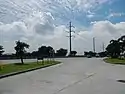  | |
| 138 kV | 7 | Used on the Visayas and Mindanao grids. | Like with 230kV transmission lines, it either uses lattice towers or steel poles, poles being used in newer construction in urban areas. Towers or poles typically 21–29 meters (69–95 ft) tall. According to National Transmission Corporation (TransCo), 60 138kV transmission lines are located in Visayas and 77 in Mindanao with a total of 137 138kV power lines in the Philippines. | ||
| 115 kV | 6 | Transmission/sub-transmission | Medium to tall poles, and H-frame towers. Lines in Ilocos primarily use conventional towers. Meralco primarily uses double-bundle conductor for upgrades and new lines. Few lines branching. |  | |
| 69 kV | 5 | Used for sub-transmission in the majority of the country. | Medium to tall poles, and H-frame towers. Lines may branch off to supply a large industrial customer or a distribution substation. Typical height and size of structures from 15–21 meters (49–69 ft) tall. |  | |
| 20/34.5 kV | 4 | Distribution | Mostly used for distribution by Meralco in most of its coverage area. Other distributors operating lines with this voltage are CEPALCO (in Cagayan de Oro), and LIMA Enerzone (at LIMA Technology Center in Lipa and Malvar, Batangas) | Medium-size poles, usually placed roadside. Multiple wires and circuits may not be obvious from imagery. Networks form large webs of lines with many branches that may carry one or two wires. Step-down transformers normally mounted on poles. Structures typically from 12–18 meters (39–59 ft), with taller poles used in major river crossings and smaller poles in narrow streets | |
| 25 kV single-phase | none | Railway electrification | International AC railway electrification voltage. No installations yet, but is being planned for the future Mindanao Railway network. | ||
| 7.97/13.8 kV | 3 | Distribution | Used by most electric cooperatives, Meralco (in southern Cavite, central Laguna, Batangas City and San Pascual, Batangas, and northern Bulacan), and other electricity distributors. Wind farms also use this to collect power from each turbine. | Medium-size poles, usually placed roadside. Multiple wires and circuits may not be obvious from imagery. Networks form large webs of lines with many branches ("laterals") that may carry one or two wires. Step-down transformers normally mounted on poles. | |
| 3.6/6.28 kV | 2 | Used by Meralco on older inner-city lines in Metro Manila. Most lines being replaced by 34.5 kV facilities. | |||
| 1,500 V DC | Railway electrification | Railway electrification voltage, used on LRT Line 2. Future usage on North-South Commuter Railway (NSCR) and Metro Manila Subway. Used with overhead lines supported by poles. | 6–9-meter (20–30 ft) poles. Most existing installations do not use separate feeder wire. | ||
| 750 V DC | Railway electrification voltage, either used with overhead lines or third rail. Utilized by LRT Line 1, MRT Line 3 and the future MRT Line 7. | For overhead contact systems only: 6–7-meter (20–23 ft) poles or gantries. Most existing installations use separate feeder wire, except the LRT Line 1 from Baclaran to Monumento. | |||
| 127/220, 400, and 254/440 V | none | Distribution | Voltage supplied to large commercial/industrial consumers, and high-rise buildings. Supplied through a three-phase transformer (usually a set of two or three single-phase ones), a large ground-mounted transformer, or an indoor substation. | Wires usually connect directly to a single building. Rarely used for wide-area distribution. | |
| 230 V single-phase | none | Standard supply voltage for homes and small businesses and industries. Supplied from a single transformer connected to 1 or 2 wires of a primary distribution line. | 9–9.5-meter (30–31 ft) poles. Lines either use two wires (most common) or three (American-style split-phase, with 115/230 kV. Example would be those by Meralco). |
Some nonstandard voltages are 350 kV for the HVDC-Leyte Luzon transmission line and submarine cable, and 13.2/23 kV for the Visayas Electric Company (VECO) distribution network in Cebu.
Most transmission lines have two circuits (6 wires), though there are also those with only one circuit (3 wires). Sub-transmission lines are often single-circuit, while distribution lines may have more that 2 circuits carried by the same poles or structures. This do not include the ground wire used for lightning protection.
Part of a distribution circuit can be fed from another substation, where one substation has to be shut down, or a line segment is being repaired. Transmission and sub-transmission lines are usually looped in most places.
Railway traction systems are fed from the distribution or sub-transmission grids. Overhead line systems may use feeders for more efficient power transmission, but this system is only used with the LRT Line 1 Roosevelt extension and the whole MRT Line 3. LRT Line 2 and the NSCR use a feeder system that combines the feeder wire with the messenger wire (the wire where the contact wire where trains collect power hangs from); the upper arm on the poles used with this system carrying lightning protection wires instead of the feeder.
Substations
Substation names are standard, and generally has the "Substation" suffix. substation=* depends on the voltages. If the higher voltage is 500 kV, 230 kV, or 138 kV, it's most likely to be substation=transmission. substation=distribution usually have an input voltage of 69 kV or 115 kV. No-name substation=minor_distribution fed by either 34.5, 23, 13.8, or 13.2 kV lines are commonly found in large buildings (e.g. malls, high-rises, college/university campuses) and supply 127/220 V or 254/440 V three-phase; otherwise, these are generally pole-mounted transformers.
Operators
See WikiProject Power networks/Philippines/Operators for guidance when tagging operators of any power line in the Philippines by region.
Tagging examples
| Image | Tags | Notes |
|---|---|---|
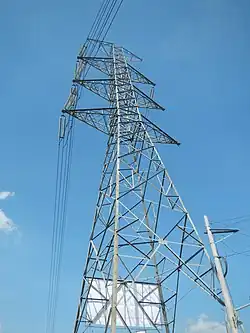 |
Transmission tower |
|
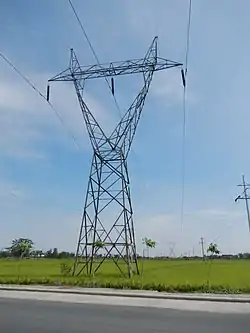 |
Transmission tower |
|
 |
Transmission tower |
|
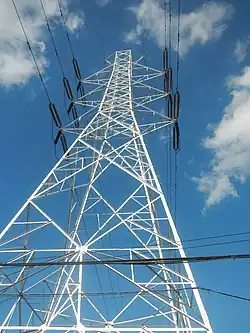 |
Transmission tower |
|
 |
Transmission tower ref=49 ref=48 Transmission line |
|
Power lines mapped
Main article: Power networks/Philippines/Power lines mapped
For a visualization of all power lines mapped in OSM, see OpenInfraMap.
Components of power lines
Main article: Power networks/Philippines/Components of power lines
Number of towers that were painted with aluminum or zinc paint
Main article: Power networks/Philippines/Number of towers that were painted with aluminum or zinc paint
Number of retired structures
Main article: Power networks/Philippines/Number of retired structures
Power line references
Main article: Power networks/Philippines/Power line references
Power line structures references
Main article: Power networks/Philippines/Power line structures references
Abbreviation of substations and power plants
Main article: Power networks/Philippines/Abbreviation of substations and power plants
Mapped transmission and subtransmission lines constructed by each companies
Main article: Power networks/Philippines/Mapped transmission and subtransmission lines constructed by each companies
Power stations/substations mapped
Main article: Power networks/Philippines/Power stations/substations mapped
List of relocated or reused and retired structures
Main article: Power networks/Philippines/List of relocated or reused and retired structures
Statistics
- Amount of painted structures: 581 (steel poles), 259 (lattice towers), 2 (portal towers). Total: 842
- Amount of reused structures: 18
- Mapped power lines: 30 (NGCP), 1 (Meralco), 2 (BATELEC-I), 5 (BATELEC-II, including lines or line section divested from NGCP in 2011), 1 (LIMA Enerzone (LIMA Utilities), all from NGCP, originally commissioned by NAPOCOR). Total: 39