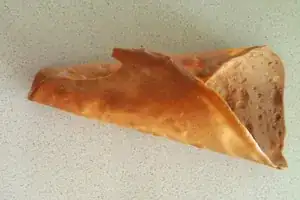
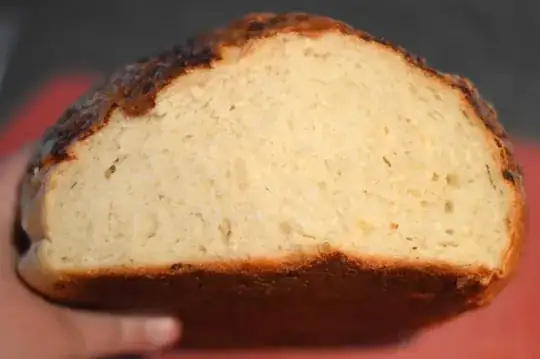
This has the looks of a heavily enriched bread. Being dense is only a side effect of this. The taste people like in enriched bread doesn't come from being dense, and if you tried any other method of making it dense (e.g. using whole flours), you'd be disappointed.
Look for recipes which use sufficient milk, fat and eggs, and try these. Although lots of fat will make it tender, not chewy. But maybe you didn't mean "chewy" as in gluten-chewy (typical for bread, gets reduced with fat) but as in doughy (turns slightly sticky when compressed).
From the looks of that loaf, most of its enrichment comes from milk, with some egg, but not too egg-heavy (will be easier to tell if you say the picture was correctly white balanced). It possibly has sugar too, but not very much of it. I'd have to touch and eat it to know if it has more fat added than what comes from whole milk. Try a standard milky recipe, or maybe a Rosinenkranz without the raisins and 1/3 of the sugar.
If you like the crust's chewiness, that indeed comes from the lye in a pretzel bread. I don't find soda to be an adequate substitute, you need much higher pH than that. It may be easier to first try to replicate the crumb properly and once you're OK with that, start experimenting with bathing the crust.
If you are a novice baker, you should 1) also learn the correct process of breadmaking (to spot bad recipes which cut corners and can't replicate properly made bread) and 2) learn correct yeast ratios. Most home recipes use awful amounts of yeast. Especially with the kind of crumb you want, too much yeast won't work well. 2% fresh or 0.7% dry is plenty (that's baker's percentages, 2% means 2 g per 100 g flour, not per 100 g dough), lower goes too. Enriched bread can take some more, but I wouldn't suggest it for dense crumb. If the recipe wants more, still use only 2% and disregard their proofing time suggestion, proofing until it has doubled its volume in each phase.
The one thing which has me somewhat puzzled, as mentioned above, is that this results in a bread which is very tasty and has the look you photographed, but is not what I'd call chewy - as Stephie called it in a comment, "Muerbes Brot", which is an adjective normally connected with shortbread pastry crusts which fall apart in the mouth. If you find it insufficiently chewy, but everything else is all right, try with with somewhat stronger flour (I assume you are from the US based on the way you use the term "pretzel", so you should have access to various strengths of bread flour), maybe even bagel flour, or add gluten to your flour. But I'd start with standard bread flour (~12% gluten), that will already make it chewier than the European versions, they use AP flour.
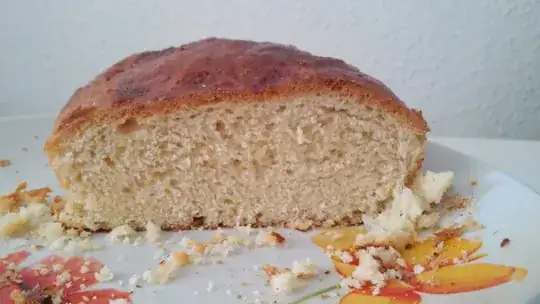
Update I baked the Butterlaible Stephie suggested in the comments. I wish I could share with her the rep I'd get from this answer. It's a visual match at least. It's certainly dense, and while not "chewy" by my standards, it's also not as tender as some other enriched breads.
A few notes:
- I didn't use lye, this is an egg wash, so not Laugenbrot/pretzel in my case
- I made it without malt, with less yeast (1.7 g for 250 g flour), left out the sugar for the sponge
- the crumb is surprisingly yellowish, even though it contains no eggs. The recipe author mentions she used a yellow wheat too, if your baker has a yellower crumb, it might be caused by this wheat or be colored additionally with beta carotenes
Verdict: it's certainly a good place to start and see how well it matches. If it is a good overall match but missing some detail, you might want to ask another question for this one specifically.