Unless there's a mistake in your code, or the coefficient on $X_1$ is not significant, I'd be inclined to trust the model output.
It's not unusual for data to behave this way. Just because $X_1$ and $Y$ are inversely related with respect to the marginal distribution of $(X_1, Y)$, as can be concluded from a scatterplot of the two variables, does not mean this relationship holds conditional on other variables.
Here is an example where $(X_1, Y)$ are inversely related, but are positively related conditional on another value, $X_2$. (The example is generated using R -- you've tagged python, but this concept is language-agnostic):
library(tidyverse)
library(broom)
set.seed(1)
N <- 100
dat <- tibble(
    x2 = sample(1:4, size = N, replace = TRUE),
    x1 = x2 + rnorm(N) / 3,
    y = x1 - 2 * x2 + rnorm(N) / 5
)
ggplot(dat, aes(x1, y)) +
    geom_point(aes(colour = factor(x2))) +
    theme_bw() +
    scale_colour_discrete("x2")
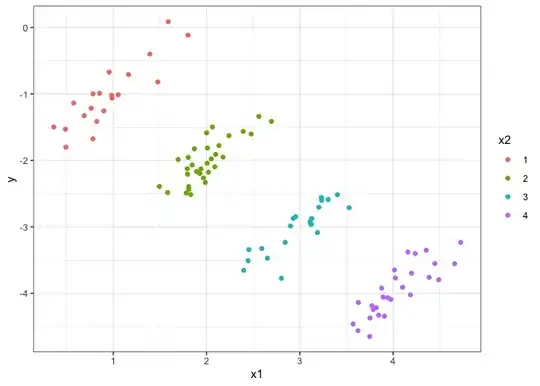
Here are the outputs of a linear regression model. You'll notice that the coefficient on $X_1$ is negative when $X_2$ is not involved, as anticipated, but is positive when $X_2$ is involved. That's because the interpretation of a regression coefficient is the relationship given the other covariates.
lm(y ~ x1, data = dat) %>%
    tidy()
#> # A tibble: 2 x 5
#>   term        estimate std.error statistic  p.value
#>   <chr>          <dbl>     <dbl>     <dbl>    <dbl>
#> 1 (Intercept)   -0.492    0.154      -3.20 1.83e- 3
#> 2 x1            -0.809    0.0549    -14.7  1.33e-26
lm(y ~ x1 + x2, data = dat) %>%
    tidy()
#> # A tibble: 3 x 5
#>   term        estimate std.error statistic  p.value
#>   <chr>          <dbl>     <dbl>     <dbl>    <dbl>
#> 1 (Intercept)   0.0189    0.0540     0.349 7.28e- 1
#> 2 x1            1.04      0.0681    15.3   1.42e-27
#> 3 x2           -2.05      0.0726   -28.2   1.60e-48
Created on 2020-04-27 by the reprex package (v0.3.0)
This concept extends to more than two covariates, as well as continuous covariates.


