Here is a recent preprint about a possible super cryovolcano on Pluto. In this study, Cruikshank et al. analyzed the morphology and composition of Kiladze, a wide (~44 km in diameter) depression at Pluto's surface. Based on its morphology and the nature of the deposits surrounding it, the authors conclude that the structure is not an impact crater but rather a caldera which would have erupted almost 1000 km3 of water-ice cryomagma:
In consideration of the size, structure, composition, and youth of Kiladze and surroundings, we interpret this region as a super cryovolcano with a resurgent caldera, having a history of one or more eruptions ejecting 103 km3 of cryolava, and possibly an unknown number of eruptions of smaller scale.
The 1815 eruption of Mount Tambora ejected about 175 km3 of material. Volcanologists usually speak in terms of volume of ejected material, which is used to define the Volcanic Explosivity Index (VEI) scale, rather than in terms of energy released. Both the Tambora and the proposed Kiladze eruption are classified VEI-7, the former in the lower end, the later in the upper, so I would argue that these events have been similar in terms of energy released. For more details about volume to energy conversion, see this answer.
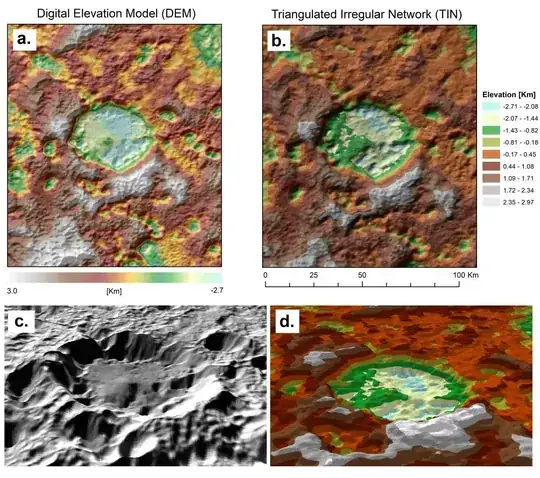 (a, b) 2D visualization of digital elevation model (DEM) and a triangulated irregular network (TIN) contour map at Kiladze area and surroundings. (c, d) 3D visualization of base map and triangulated irregular network (TIN) map at Kiladze area and surrounding. CC BY Cruikshank et al. (2023).


