14

The evidence seems clear that there is an interrelationship between solar luminosity, greenhouse gas concentrations, and temperature.

Has temperature as a function of luminosity and greenhouse gas concentrations been developed? If so, what is the accuracy and precision?

  • 2
    If you use the solar irradiance of the sun you can derive the blackbody temperature of the earth, which is 33 degrees celsius less than the Earth's actual temperature. The difference due to greenhouse gas concentrations and their relationship to energy trapping on earth is derived using radiative models and global climate models. – f.thorpe Jul 20 '14 at 03:56
  • @farrenthorpe Thank you farrenthorpe! Yes, that's what I'm looking for! Is there a general function? Has it been researched? It seems that if climate change is well-proven, this function would be detailed with narrow error. Is it available? Thank you so much in advance! –  Jul 20 '14 at 04:04
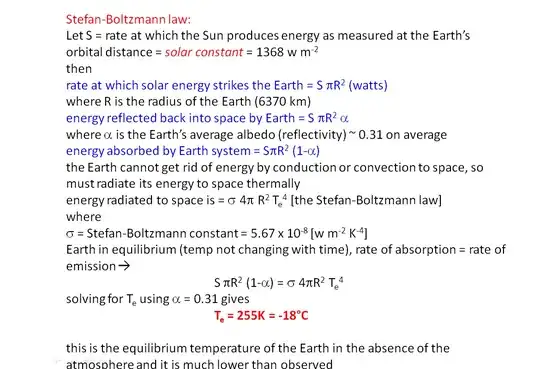
  • the equilibrium temperature of the earth with no atmosphere can be derived from an energy balance equation where the energy in is equal to the solar constant times the surface area of the Earth as a disk (as seen from sun = pi r squared) times (1 - albedo). This is equal to the stefan boltzman constant times the surface area of the Earth as a sphere ( 4 pi r squared) times the equilibrium temperature of the Earth to the 4th power. – f.thorpe Jul 20 '14 at 04:43
  • @gracchus that there is no simple function for the dependency of temperature on green house gases has no bearing on the soundness of climate science. It simply reflects the complexity of the systems involved. There is no simple function that tells you how fast a plane has to go in dependency of it's shape, nevertheless we are pretty sure we can make safe statements about that issue using complex simulations. – taupunkt Jul 20 '14 at 10:07
  • @taupunkt Seems strange, since gas is well-mixed in the atmosphere, that based upon atmospheric volume, depth, some greenhouse effect formula, and luminosity that a general formula is unavailable. I could develop a relatively simple function for a plane shape to determine speed necessary to fly. The more variables, the less error. –  Jul 20 '14 at 15:53
  • @Gracchus I'm sure you can construct a toy model that gives you the right ball-park numbers. You can do the same with the atmosphere. You'll probably end up with models that are able to give you ball-park numbers for the planets in the solar system. But with regard to climate change you need more accuracy just as you need more accuracy to seriously construct a plane. – taupunkt Jul 20 '14 at 16:09
  • @taupunkt I absolutely agree, but I'm looking for something that can easily be demonstrated to a schoolchild or layman with reasonable accuracy & precision. I can demonstrate basic rocketry with Newton, and I'd probably chart a course within reasonable bounds for demonstration, but I'd probably want to use Ito when I actually fly one. –  Jul 20 '14 at 21:02
  • 2
    @Gracchus maybe a look at David Archer's book 'Understanding the forecast' could be interesting for you. He explains the basic laws that go into the climate models and uses some toy models to illustrate key concepts. I found it very readable. – taupunkt Jul 20 '14 at 21:57
  • 1
    Raymond Pierrehumbert's book "principles of planetary climate" is a good primer on thse sorts of topics. There is also a collected volume called "The Warming Papers", which contains a number of classic papers on climate change which show the progression of ideas (following the history can be a useful way of understanding why climate science does things the way it does). You can make simple models of climate that a student (or me) would understand, but as soon as you try to take into account factors such as the position of the continents (which does matter), you end up with something – Dikran Marsupial Jul 21 '14 at 18:06
  • you can't write as an equation and you have to perform simulations instead. This is done all the time in physics; the basic idea (Monte Carlo simulation) used by climate models was invented for the Manhattan project, for problems in statistical physics that you can't solve in closed form using equations. – Dikran Marsupial Jul 21 '14 at 18:08

1 Answers1

10

You need a radiative transfer model and global climate model to do it with greenhouse gases. you can derive the temperature without greenhouse gases as discussed below: enter image description here
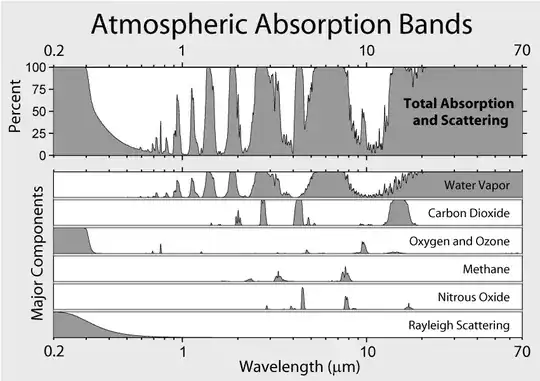
The absorption is highly variable depending on wavelength and can be seen in this graphic:
enter image description here

Radiative transfer through the atmosphere is specific to pressure, temperature, and wavelength. So in order to calculate the contribution of greenhouse gases you need to know their concentration distribution both vertically and horizontally not to mention an accurate representation of the atmospheric conditions. It's not one general function... it's millions of functions that all get integrated together and vary dynamically in time and space. I suggest you look at the HITRAN database for the complexities in absorption potential of different greenhouse gases.

You may also be interested in climate sensitivity paramaters. From wikipedia http://en.wikipedia.org/wiki/Climate_sensitivity :

"For coupled atmosphere-ocean global climate models (e.g. CMIP5) the climate sensitivity is an emergent property: it is not a model parameter, but rather a result of a combination of model physics and parameters. By contrast, simpler energy-balance models may have climate sensitivity as an explicit parameter. (ΔTs) = λ (ΔRF) The terms represented in the equation relate radiative forcing (RF) to linear changes in global surface temperature change (ΔTs) via the climate sensitivity λ."

This is convenient because if you know the change in concentration of a gas and the corresponding RF you can compute a change in surface temperature. Though, I believe the climate sensitivity parameters are particularly for certain time and concentration regimes.

f.thorpe
  • 13,583
  • 2
  • 46
  • 89
  • Thank you farrenthorpe! Does this mean that a general function has not been developed? That seems odd considering the confidence placed in climate change. –  Jul 20 '14 at 04:55
  • 3
    Radiative transfer through the atmosphere is specific to pressure, temperature, and wavelength. So in order to calculate the contribution of greenhouse gases you need to know their concentration distribution both vertically and horizontally not to mention an accurate representation of the atmospheric conditions. It's not one general function... it's millions of functions that all get integrated together and vary dynamically in time and space. I suggest you look at the HITRAN database for the complexities in absorption potential of different greenhouse gases. I'll add an absorption graph. – f.thorpe Jul 20 '14 at 04:59
  • 1
    @Gracchus there is a climate sensitivity parameter for each greenhouse gas that can be used to estimate the change in radiative forcing that gas has on the earth's climate. That may be what you are looking for. You can also derive the contribution of greenhouse gases by looking at the Earth's absorption spectrum from space and using the black body reference curve of the appropriate temperature. – f.thorpe Jul 20 '14 at 19:57
  • 1
    comments have been added to the answer – f.thorpe Jul 24 '14 at 02:34