18

Aside from the fraction of water stored as ice on land and temperature of the water, are there other factors that change sea level, and if so what are is the magnitudes of the these changes?

For example, by how much does sediment and soluble matter entering the ocean change sea level? What about volcanoes and tectonic activity? Is there a tendency toward hydrostatic equilibrium where the Earth is entirely covered by an ocean of uniform depth?

Matt Hall
  • 11,001
  • 1
  • 44
  • 67
DavePhD
  • 5,972
  • 20
  • 51

2 Answers2

24

Yes, there are lots of other factors.

Factors affecting sea levels are no different from other natural processes: there is a large number of coupled, non-linear effects, operating on every time scale, and at every length scale, and across many orders of magnitude.

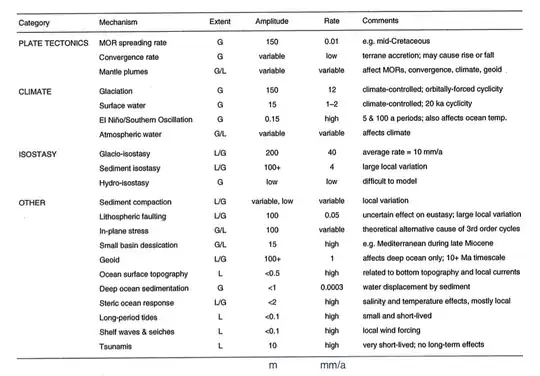
The Wikipedia page Current sea level rise lists many of the known processes. And I wrote a blog post, Scales of sea-level change, a couple of years ago with a long list, mostly drawn from Emery & Aubrey (1991). Here's the table from it:

Factors affecting global sea levels

Reference Emery, K & D Aubrey (1991). Sea-Levels, Land Levels and Tide Gauges. Springer-Verlag, New York, 237p.

Matt Hall
  • 11,001
  • 1
  • 44
  • 67
  • What are the units for the table? Amplitude in metre and rate in mm/year? – gerrit Oct 01 '14 at 14:46
  • Ah, good point. I'll edit it. (But m and mm/a is correct.) – Matt Hall Oct 01 '14 at 14:48
  • This list misses the biggest (besides melting ice), which is thermal expansion. – David Hammen Oct 01 '14 at 22:41
  • @David: 'Steric ocean response' includes thermal expansion. A quick search (e.g. this IPCC FAQ) suggests the magnitude is larger than the table shows (at a rate of ~1–2 m/ka it seems), but I can't find anything treating it on geological time scales, only ~decades. Any suggestions? – Matt Hall Oct 02 '14 at 11:43
  • 1
    @David: OK, I have some numbers. This paper mentions 0.12 m per 10^24 J, and Wolfram Alpha says the world ocean is ~10^21 L, so a rise of 1°C needs 5.10^24 J, so for changes of a few degrees, the effect is on the order of 1–2 m. Of course, changes in temperature are far from evenly distributed, but it seems like the table is in the right ballpark. – Matt Hall Oct 02 '14 at 12:24
  • @kwinkunks how can glacio-isostasy have a greater amplitude than glaciation (200 vs 150 according to the table)? I thought isostasy would be less because rock is denser than ice. – DavePhD Sep 09 '18 at 14:41
  • @DavePhD I've seen the effects of glacio-isostasy taken to include the sea level drop from the missing water (now trapped on land). So maybe it's not 150 from glaciation + 200 from isostasy, but actually 200 from glaciation, out of which 50 is accounted for by the land depression? A quote from the reference would be handy here :D – Luaan Nov 19 '19 at 08:11
7

This link is a scientific talk by geoscientist Jerry Mitrovica (Harvard University) called 'Sea Level Fingerprints of Ice Sheet Collapse'. It's about an hour long, fairly technical, and focused on ice sheet contributions to sea level change (it was for an audience of other scientists), and has some good background related to this question. I highly recommend watching if you have the time.

J. Musser
  • 399
  • 1
  • 4
  • 15
  • 1
    Welcome to Earth Science! While this may theoretically answer the question, it would be preferable to include the essential parts of the talk here, and provide the link for reference. If the link goes bad, this answer will be rendered useless. – J. Musser Oct 01 '14 at 17:30
  • Yes, I understand, but I thought it was better than nothing. I simply didn't have the time to produce a synthesis of Mitrovica's work. This is why I haven't participated in these forums in the past. I likely won't be able to provide clear, robust explanations to this forum due to other obligations. – Brian Romans Oct 02 '14 at 14:34