4

If radioactive decay supplies only about half the Earth’s heat, what are the remaining sources of heat?
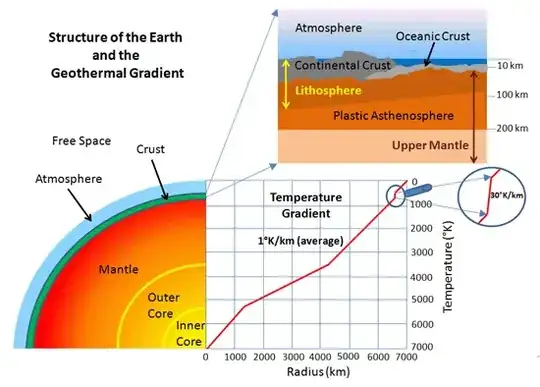
GRAPHIC-1: Structure of the Earth, GRAPHIC-2: Geothermal Gradient, GRAPHIC-3: Temperature Gradient of Geothermal Gradient

blunders
  • 4,601
  • 2
  • 27
  • 52
  • this answer is similar: http://earthscience.stackexchange.com/questions/428/could-earths-core-lose-its-heat/429#429 to what you might want, though not exactly – Neo May 04 '14 at 17:53
  • 2
    I understand "cooking" as "phase transition from liquid to gas". Is that what you mean? – BHF May 04 '14 at 18:13
  • 2
    I took the title question figuratively, interpreting it as if the title was "What keeps the center of the Earth so blazin' hot?" Cooking is just a figure of speech. – David Hammen May 04 '14 at 19:20
  • Please provide some reference to evidence that only half of Earth's heat flow can be explained by radioactive decay. I expect there's differing options about that. You stated it as if it were a fact. – Mark Rovetta May 04 '14 at 19:42
  • @BHF: David Hammen is correct, the use of "cooking" is figurative not literal; though to be clear, "cooking" does not even require heat, though that's more of a topic for Cooking.SE or English.SE. – blunders May 04 '14 at 20:39
  • Please add an image description for accessibility reasons. Yes! This stackexchange site is far too reliant on images. It is not accessible. – David Hammen May 06 '14 at 03:14
  • @DavidHammen: Already added an image description, what am I missing? – blunders May 06 '14 at 03:18
  • @blunders - Your question comprises seventeen words and four images (one of which is just seven words but those seven words are completely unreadable to the visually impaired). Those other three graphics: Keep in mind the dictum "an image is worth a thousand words." That means our question is over 2800 words shy (just kidding). On the other hand, it is a very good idea to keep in mind those who can't see those graphics. This site is over-reliant on imagery. Those images mean absolutely nothing to the visually impaired. – David Hammen May 06 '14 at 04:10
  • I've been asked here and at sister sites to add some graphics to my answers. I don't do that. For one thing, I'm not visually-oriented. For another graphics are very non-508 compliant. – David Hammen May 06 '14 at 04:17
  • @David Hammen: Yes, I am aware of the reasoning, though honestly never though about it; which isn't to say it's not important. I'm adding alt-text to the my images going forward. – blunders May 06 '14 at 04:20
  • It's not easy. I work with someone who can't see. To him, the visually impaired are those humans who are who are blinded by what they see. We sighted people rely far too much on what we can see. It's better to use words and mathematics with regard to the sciences. – David Hammen May 06 '14 at 04:29
  • And in this case, summarizing those four pictures is easy. The temperature inside the Earth increases about 1 degree Kelvin per kilometer of depth, reaching about 7,000 Kelvin at the center of the Earth (see the Preliminary Earth Reference Model for details.) Why is that? The dictum of "a picture is worth a thousand words" doesn't hold here, and that is often the case. – David Hammen May 06 '14 at 04:40
  • @DavidHammen: Guess I missed "those words in the picture" (seen them now, but did not before) - and it's unclear how best to use the feedback you've provided. Please just edit the question directly to reflect the changes you are say need to be made to address the concerns you have. Thanks. – blunders May 06 '14 at 14:06

2 Answers2

6

If radioactive decay supplies only about half the Earth’s heat, what are the remaining sources of heat?

Mostly it is residual heat energy from when the Earth was very young. The biggest source came from the kinetic energy of all the bodies, big and small, that collided to form the Earth being converted to heat. The differentiation of the Earth added even more heat energy to the Earth.

In addition to radioactive decay, the on-going freezing of the outer core material onto to the inner core adds a bit more heat to the system, but neither one compensates for heat transported through the mantle and crust and then out into space. Note that this heating from below is but a tiny portion of the overall energy budget for the Earth's surface.

Even the Earth's surface was very hot shortly after the formation and differentiation of the Earth. While the surface cooled quickly (geologically speaking), the interior has not. The key reason is that 2,890 km of rock makes for a fairly thick blanket.

David Hammen
  • 23,587
  • 1
  • 60
  • 102
  • It would be nice to have an equation that actually puts out the approximate numbers for the heat flow. Yes, 3000km of rock is a fairly thick blanket, but 5 billion years is a very long period for cooling down from the primordial non-radioactive heat. – 0tyranny0poverty May 25 '17 at 19:34
4

This is an exciting topic of geophysics, because Earth's heat flow represents a classic question for earth science, heat source distribution is critical to modeling mantle convection, and because the application of geoneutrinos is cutting-edge experimental physics. The original publication reporting the use of KamLAND geoneutrino data was in Nature, and well worth reading. An online pdf is available here:

Partial radiogenic heat model for Earth revealed by geoneutrino measurements

Mark Rovetta
  • 3,800
  • 16
  • 26