5

Everyone is saying we are in a global warming, an unnatural one at that because of CO2.

Has there ever been a 'global warming' in Earth's history? I know that global cooling is cyclical and 'looks' like global warming at the beginning of the cycle and luckily it is cyclical. There was a good explanation that the 'great dying' was because of global warming. If there is such a thing what would make global warming cyclical.

Venus is global warming for sure but what could have stopped the cycle of warming to go to cooler therms and stop the 'Venus' effect that can not be changed? There is a negative feedback for global cooling thus keeping that in check. Is there a negative feedback for global warming?

Gimelist
  • 23,122
  • 4
  • 68
  • 133
stormy
  • 167
  • 1
  • 9
  • 3
    I might give this one a shot, but if anyone else wants to, feel free. I feel I should point out that what's happened with Venus is a runaway greenhouse effect, essentially a permanent effect. The only thing that could cool Venus down would be to knock it out somewhere close to or past Mars' orbit. Venus is a tough example, also, because we don't know enough of it's geological history. That lack of knowledge of it's history and it's very different "runaway" situation makes Venus largely irrelevant. Good question regarding Earth though. – userLTK Mar 25 '16 at 02:53
  • 5
    For prehistoric examples, look up the Paleocene-Eocene Thermal Maximum (PETM) and the Permian-Triassic Extinction event. Also note that Venus receives approximately twice as much solar energy per unit area as Earth does. – jamesqf Mar 25 '16 at 06:04
  • 3
    I'm trying to work out this question, but as I read it, I'm not sure what you're asking, when you say this "I know that global cooling is cyclical and 'looks' like global warming at the beginning of the cycle and luckily it is cyclical" and this "If there is such a thing what would make global warming cyclical." I don't quite see what you're asking. Very loosely speaking, negative feed-backs aren't that important, it's positive feedbacks that drive the pretty significant temperature changes. – userLTK Mar 25 '16 at 08:34
  • userLTK...what would you call positive feedbacks? – stormy Mar 28 '16 at 00:45
  • 1
    @stormy Glaciers work as a feedback mechanism in both directions. As Ice forms over land, Albedo drops, more light is directly reflected back into space, Earth cools. Oceans are a feedback as they hold more CO2 as they cool. Methane which forms, trapped under glaciers and tundra, as the ice thaws, Methane is released and that warms the Earth. Water is a greenhouse gas and warmer air holds more water vapor (not clouds, just humidity), colder air holds less. Feedbacks are anything that amplify a temperature change. They're significant factors. – userLTK Sep 04 '16 at 09:10
  • Great answer! You just cited the 'cyclical' part of global cooling so very well. What I understand that you are supporting, is that the first signs of global cooling are those that look like global warming and then negative as well as the positive feedbacks in this very natural normal climate change towards cooling. Anthropomorphic CO2 is just not a large enough factor to precipitate change. If anything is going to screw up the normal changes, it is this spraying to practice controlling the weather. Water vapor (if that is all) is a big deal GH gas! – stormy Sep 06 '16 at 19:23
  • @userLTK Help me understand negative feedback and positive feedback. Positive feedback perpetuates a condition (warmer to warmer), negative feedback slows or reverses a condition (warmer to cooler)...am I getting this correct? What I've been hearing are poles are gaining more ice not losing ice. And the UN just had a special session on CHEMTRAILS. Just to talk about chemtrails. Doesn't that make them REAL over and above any hollywood action? How can anyone keep saying these persistent contrails are normal and 'natural'? If you were assigned the task to control weather what would you do – stormy Jan 05 '17 at 20:51
  • 1
    @stormy They don't like conversation here, so perhaps it should be turned into a new question, but my understanding a negative fedback doesn't turn warmer to colder, per say, it turns warmer to less warmer. Think of a positive feedback as a slippery slope where one step forward you slide forward 2 more and a negative feedback as drag where 1 step is against resistance so you take half a step. The poles (glaciers) gaining ice may be true, but it's just one glacier, the biggest one, the East Antarctic, which isn't evidence against climate change. On Chem trails - no idea but I smell bunk – userLTK Jan 06 '17 at 02:05
  • OH WELL. There is plenty of space and I kinda push the limits to find the true limits. Great...makes sense. Negative feedback from 'warming' is to less warm which to me is going the other way to cooler. And that feedback continues to solidify the cooling trend. Yes??? This makes sense to me and I feel better. On Chem trails...go check out Geoengineering...on this internet. Go out and just look and think about normal contrails and persistent contrails. Think about why US military has sworn to be in control of weather/climate by 2025. Think about when these patents (go see) started... – stormy Jan 06 '17 at 22:48
  • @userLTK Been awhile. I got dragged into so much on AGW that hell, I had to freshen up and learn lots lots lots more. I am at a firm 100% CO2 will never be a problem for our environment on this planet. Chemtrails...hummm. Amazingly in our face true. Please go look up those patents. That will help with authentication of sorts. Just attaching the label 'conspiracy theory' to any problem effectively negates that problem in this day/age. I also heard some scientist explaining that in the natural world positive feedback doesn't happen. Negative feedback creates stability, homeostasis. – stormy Oct 09 '17 at 02:00
  • ...and...I hope that others don't think Venus's situation has ANYTHING to do with CO2 as a causative element for Venus's condition. Being so close to the sun I also have a problem with...Venus is in the Goldilocks zone albeit on the edge, yes? No? Cloud cover would be a good thing. I think Venus's problem is that Venus PRODUCES heat from it's interior. Just a few little tweaks caused Mars and Venus to...change where they wouldn't make great homes for us humans. Mars btw has about the same percentage of CO2 as Venus's atmosphere. – stormy Oct 09 '17 at 02:20
  • @stormy You "think" Venus produces heat from it's interior and that's why it's so warm? You're just making this up as you go along, aren't you? Cloud cover is a good thing if we're talking cooling. That keeps Venus from getting too much energy from the sun but the energy it gets it's very good at keeping. And it's not the percentage CO2 it's the total amount. Venus has like 10,000 times more CO2 than Mars. – userLTK Oct 09 '17 at 03:22
  • Venus's cloud cover reflects heat as far as I understand...please correct me if I am wrong, heavens! Venus has been found to still be highly volcanic. That tells me the heat held in by the thick cloud cover has to come from another source rather than the sun whose energy is reflected into space. Am I wrong? Mars...thinner, atmosphere of course tinier planet but the percentage is almost the same 95% in composition. On Venus they say the sulfur in the atmosphere is a problem yet they report...96.5% CO2 and 3.5% Nitrogen. That is 100%. Where is the sulfur? See what I mean? – stormy Oct 09 '17 at 04:52
  • @stormy Venus cloud cover does reflect sunlight very effectively. Volcanoes generally make it colder. Venus isn't highly volcanic though it has been in the past but that doesn't matter. Venus atmosphere has SO2 - a global cooling gas. Only 20% of sunlight actually gets inside Venus' atmosphere to warm the planet, but it's CO2 is very good at retaining that 20%. Earth is the opposite, about 60% of sunlight reaches the surface, but Earth isn't abundant with greenhouse gas, heat leaves fairly easily too, but less easily than it used to. SO2 is a trace gas on Venus, trace is enough. – userLTK Nov 07 '17 at 07:12
  • Venus has its own internal heat engine. Having almost 100% CO2 that actually resembles 'blankets'...holds the heat within. Funny, Mars' atmosphere is 95.3% CO2...how different can the two planets be...sigh. Please tell me this AGW is finally OVER. CO2 is simply never going to be a problem, never has been a problem...thank goodness we have the CO2 we do have. 400ppm and easily do beautifully up to 2000ppm. 150ppm and we all die...plants and animals. What an amazing scam they've put us through. We are now in a Grand Solar Minimum. They give names to these 206 cycle solar hibernations – stormy Nov 08 '17 at 07:54
  • This stuff is real. Funny why the media doesn't mention this in our face factoid of life. This one is called the 'Eddy Minimum'...the last was the Dalton Minimum, the one before that was the Maunder Minimum and I think the one before that was the 'Little Ice Age' and then there are many many more named Grand solar minimums. The sun of course causes climate. The CO2 thing is a complete joke. These minimums are brutal, you have to go check this stuff out! Included with these cyclic minimums are major earthquakes and polar shifts. Facts. Look up the New Madrid Fault and the last minimums. – stormy Nov 08 '17 at 07:59
  • https://www.youtube.com/watch?v=ZTJCY6M-3fY&t=500s John Casey is the most credible of all videos, scientists. Watch and learn get prepared or be surprised. – stormy Nov 08 '17 at 08:04
  • Shoot, CO2 is used as a coolant on this planet...dry ice? Water vapor essentially reflects IR, volcanic particulates do the same. Forget CO2, water vapor and anything related to global warming. Not a part of anything on this planet, never has been a problem...but we most certainly are in a major global cooling event...that happens every 206 years. Wonder why you haven't heard about the Grand Solar Minimums? – stormy Nov 08 '17 at 08:08

1 Answers1

7

Has Earth's climate ever changed? Sure.
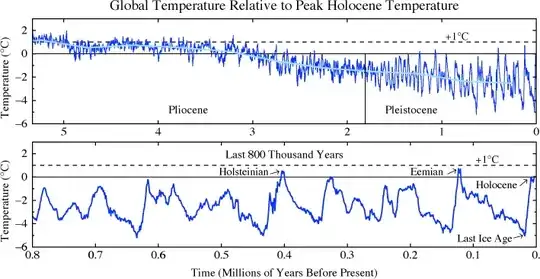
paleoclimate record [1]

There are many feedbacks within the climate system, some negative as you mention but some also positive. A well-known positive feedback is the greenhouse gas effect, which in the present age is caused by anthropogenic fossil fuel emissions. Increasing greenhouse gases (GHG) causes the atmosphere to trap more longwave radiation and increase the temperature. Negative feedbacks can occur in the climate, such as the "Planck" feedback which describes the T$^4$ dependence of radiation emission--so as the planet warms it emits an even larger amount of radiation.

Climate models already take into account many of these feedbacks, but one of the largest unknowns is the effects of clouds and aerosols on the climate. The distribution of phase of clouds may change as the climate changes, which could possibly counteract the warming (as made popular in the hotly-contested Iris hypothesis [2]) or further enhance the warming.

A forcing related to clouds that further complicates their feedback is the aerosols that they form on. Let's say the climate warms a lot and the planet goes into a major drought. That will cause more deserts which will increase the amount of dust in the air. That dust (for a given amount of water) could potentially suppress precipitation in the clouds, thereby extending their lifetime and increasing the amount of sunlight reflected. Without fully knowing the distribution and effects of aerosols (and their respective impacts on clouds), an accurate estimate of cloud feedbacks is difficult.

A runaway effect on Earth could technically be possible. You talk about feedbacks as a mechanism to prevent that, but some mechanisms are not easily reversible. Thinking about the ice coverage in Earth's polar regions, if all of that ice melts for a given increase in T, decreasing T does not necessarily allow that ice to grow back to the same coverage...and especially not at the same rate.

So a changing climate is a complex system with many different interrelated components that cannot simply be predicted by a $dT/dt = dGHG/dt$ relationship. There are numerous feedbacks that are all dependent not only on each other but also sometimes-irreversible processes.

Budyko's Bud
  • 221
  • 2
  • 4
  • What do you know about Grand Solar Minimums that happen every 206 years? We have plenty of history to know what happens and it ain't pretty and we should be getting prepared. Global warming is a done deal, over, totally put to bed with all the other lies. https://www.youtube.com/watch?v=ZTJCY6M-3fY&t=500s Check this guy out, John Casey who has been systematically barred from the internet, news, speaking events because he is trying to warn us about the Eddy Minimum we have been in since 2004...should last at least 20 to 30 years could last hundreds. Associated with earthquakes; New Madrid – stormy Nov 08 '17 at 08:13
  • 1
    @stormy lol..... – user253751 Jan 15 '20 at 13:35
  • https://principia-scientific.org/evidence-co2-is-not-a-greenhouse-gas/ – stormy Jan 29 '20 at 05:46