I do know that the atmosphere protects life on Earth by absorbing ultraviolet solar radiation, warming the surface through heat retention (greenhouse effect),and reducing temperature extremes between day and night (the diurnal temperature variation). I wonder what temperature would earth reach if there was no atmosphere?.
Asked
Active
Viewed 5.1k times
38


-
4My recollection is an average sufrace temp of 255 K based on radiative equilibrium. I'll make an answer if I can back that number and how it is determined. – casey May 07 '14 at 03:59
-
5The question is a little ambiguous. Are you asking about the temperature difference between the earth with surface as it is now, but without an atmosphere? Or about the earth with no atmosphere and with a bare surface? It makes a significant difference to the answer. If you're just interested in how much difference the greenhouse effect gives, then it's best just to ask that explicitly - and the answer then, as casey says, is a surface temp of 255 K, and a temp diff of about +33 K – 410 gone May 07 '14 at 07:28
-
@EnergyNumbers What I meant to ask was usual temperature one can read on thermometer. – Praveen Kadambari May 07 '14 at 08:01
-
1OK. Of the earth exactly as the surface is now, just in the absence of the atmosphere (that is, what it would look like the instant the atmosphere vanished)? Or of the earth without the atmosphere, and if the Earth's surface was like the moon's: no water, no snow, no forests, etc (that is, what the surface would come to look like after centuries of no atmosphere)? – 410 gone May 07 '14 at 10:06
-
2Assuming no change to the Sun, and after the atmosphere vanishes we've allowed enough time for all water to disappear, all ice to sublimate, all dead flora and fauna to crumble to dust, etc.? Then I would expect temperatures to be very similar to the Moon's, modified by a slightly higher albedo (the Moon is quite dark, and there could be a bright coating of salt where the oceans used to be) (-, but might radiate less at night) and a little bit more heat flow from the Earth's interior (+). A lot depends on the history of the planet -- did it ever have oceans, etc. – Phil Perry May 07 '14 at 16:28
-
The same as Moon. – Anixx May 29 '15 at 14:01
-
The moon's temp swings from 253F in sunlight to -243F in shadow. Calculating the mean does not give a realistic view of what it would be like if the Earth had no atmosphere. The swing from day to night would be as drastic. – CHRIS Aug 24 '15 at 15:14
3 Answers
32
According to Wikipedia an approximate average surface temperature for a bare earth is 274.5 K. This scenario is quite reasonable in my opinion as stripping the atmosphere without changing much else would (on a geological timescale) rather quickly result in a bare earth without ice caps or vegetation, causing circumstances quite close to those on the moon. (I assume the Earth's magnetic field protecting both the atmosphere and life below it has disappeared as well)
This is estimated by comparing the black body radiation of the Earth and Moon, which is then corrected for albedo (fraction of incoming radiation that is reflected) and emissivity (ability of a material to emit radiation), which are properties of a material. Since the Earth and moon are both at the same distance to the sun and made up from the same material on average, measurements of the albedo and emissivity of the moon can than be used as estimations of these properties for the Earth.
The black body radiation of the sun is calculated with the Stefan-Boltzmann law:
$$P_{\text{S,emit}} = 4\pi R_S^2 \sigma T_S^4$$
$P_{\text{S,emit}}$ is the emitted energy by the sun, $R_S$ is the radius of the sun, and $T_S$ is the temperature of the sun. The fraction of this energy recieved by the Earth is then proportional to the circular surface area facing the sun and the energy density at the distance $D$ between the Earth and the sun.
$$P_{\text{SE}} = P_{\text{S,emit}}\left(\frac{\pi R_E^2}{4\pi D^2}\right)$$
$R_E$ is the Earth's radius. Using albedo $\alpha$ the absorbed energy can be calculated:
$$P_{\text{E,abs}} = (1-\alpha)P_{\text{SE}}$$
Applying the Stefan-Boltzman law to the Earth, corrected for the emissivity $\overline{\epsilon}$, the emitted energy is then:
$$P_{\text{E,emit}} = \overline{\epsilon} 4\pi R_E^2 \sigma T_E^4$$
Assuming energy equilibrium $P_{\text{E,abs}} = P_{\text{E,emit}}$ we can now calculate $T_E$:
$$\begin{aligned} \frac{(1-\alpha)4\pi R_S^2 \sigma T_S^4\pi R_E^2}{4\pi D^2} & = \overline{\epsilon}4\pi R_E^2 \sigma T_E^4 \\ T_E^4 & = \frac{(1-\alpha)4\pi R_S^2 \sigma T_S^4\pi R_E^2}{\overline{\epsilon}4\pi D^2 4\pi R_E^2 \sigma} \\ T_E^4 & = \frac{(1-\alpha) R_S^2 T_S^4}{ 4\overline{\epsilon}D^2 } \\ T_E & = \left( \frac{(1-\alpha) R_S^2 T_S^4}{4 \overline{\epsilon}D^2 }\right)^{\frac{1}{4}} \\ T_E & = T_S \left( \frac{(1-\alpha) R_S^2}{4 \overline{\epsilon} D^2 }\right)^{\frac{1}{4}} \\ T_E & = T_S \sqrt{ \frac{ R_S \sqrt{\frac{1-\alpha}{\overline{\epsilon}}} }{2 D } } \end{aligned}$$
Finally we only need to insert the correct values:
- $R_S = 6.96\times 10^8$ m
- $T_S = 5778$ K
- $D = 1.496\times 10^{11}$ m
- $\alpha = 0.1054$ (assuming value of the moon)
- $\overline{\epsilon} = 0.95$ (assuming value of the moon)
This gives us a temperature of 274.5 K.
Note that there are many factors that can cause local and temporal variations. For example, incoming radiation varies with latitude and season, and if the removal of the atmosphere would be caused by a dying sun that grows to engulf the earth temperatures would be much higher than this. All in all, to account for all those factors a very large model must be made that can analyse the influence of each factor, including the decrease in temperature of a dying sun etc., but that would be nearly impossible to build if only for the resources it would take to do so.
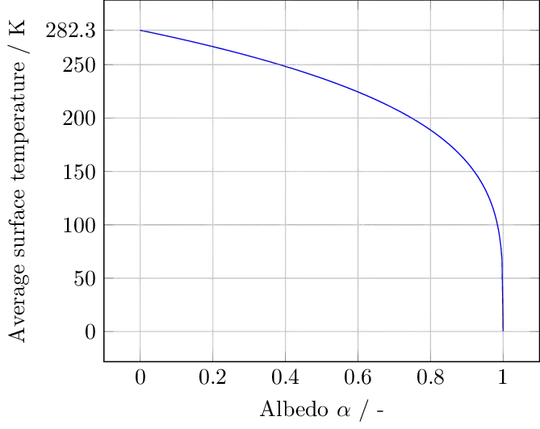
Since one of the most contested factors is the albedo after the atmosphere is removed the following graph shows how the average surface temperature changes with albedo. At an albedo of zero all incoming solar radiation is absorbed, while at 1 all radiation is reflected. Note that the temperature of 0K is an effect of the assumed equilibrium between incoming and emitted radiation, which will not hold at that point. As said above, the albedo for a bare earth will be approximately 0.1, while current values on average range from 0.3-0.4, largely contributed to by clouds. An average for the albedo of the Earth in its current vegetated state, but without clouds I haven't been able to find.
As stated by @ardie-j in his answer, another possible fate of the Earth could be that it gets covered in ice, as another Snowball Earth Event. In that case the albedo would rise to levels ranging from 0.4-0.9, resulting in a drastically cooler Earth.

hugovdberg
- 2,672
- 24
- 38
-
According to your wikipedia link, the temp is 254-255 K. But you've reported it as saying 274.5 K. Any idea where that discrepancy comes from? – 410 gone May 07 '14 at 07:04
-
And I think you've got a mistaken in the final step: in the line before, in the denominator, you've got $(D^{2}4)^{\frac{1}{4}}$, but then it gets changed to $(D^{2}4)^{\frac{1}{2}}$ – 410 gone May 07 '14 at 07:08
-
2@EnergyNumbers Please read the wikipedia article more carefully. The 254K is the BLACK BODY temperature, the value of 274K I provide here is corrected for albedo and emissivity of a bare earth without atmosphere and thus a more realistic value than the plain black body radiation. – hugovdberg May 07 '14 at 07:08
-
in which section of that wikipedia page does it say the temp is 274.5K (which is what you say on the first line of your answer)? – 410 gone May 07 '14 at 07:10
-
2@EnergyNumbers fixed a couple of copy paste errors, and it doesn't say 274.5K but 1.36C instead (a couple of lines below the 254K), but I prefered to use Kelvin throughout my answer. – hugovdberg May 07 '14 at 07:13
-
-
@EnergyNumbers the values of 0.3-0.4 are the current average albedo of the earth as far as I can see, and not for a bare earth, which would be closer to that of the moon. (see for example this or this link) – hugovdberg May 07 '14 at 07:23
-
2But isn't the question about earth in the absence of the atmosphere, rather than a bare earth? Now, I agree there's an ambiguity there in the question because of that. Do you think it might be worth explicitly dealing with that ambiguity? – 410 gone May 07 '14 at 07:26
-
2@EnergyNumbers I think an earth without atmosphere would quickly turn into a bare earth, or never had plants over it. Besides, large parts of the albedo are caused by clouds and ice coverage, removing the atmosphere would at the very least remove the clouds, so still decrease the albedo, and cause a higher temperature, although that is probably hard to qualify. – hugovdberg May 07 '14 at 07:30
-
I agree. And the ambiguity makes a big difference, doesn't it: 20 Kelvin or so (and thus the delta is either 13 or 33 Kelvin, which is a huge relative difference). I've added a comment asking the OP to clarify the question, so we can get to the bottom of what they really want to know. – 410 gone May 07 '14 at 07:34
-
And what about latitude, shouldn't you give figures at a standardised latitude, and what is the min/max difference according to latitude & seasons? – winwaed May 07 '14 at 13:52
-
@winwaed there are many factors unaccounted for in this answer, I added some comments on that, but if you have a better answer than mine, please post it, this isn't wikipedia, as someone already said in the chat.. – hugovdberg May 07 '14 at 15:14
-
-
This is mostly a math question, but why does R(E), the radius of the Earth, stop being a factor by the final formula? It seems like that would be a major factor involved in how much energy it absorbs, but it seems to get cancelled out 3 steps before the end. The math is a bit beyond me, can anyone explain how that works? I'm trying to adapt this equation for other planets like Mars and Venus, and I'm not sure how to factor in their differing sizes. – Nerrolken Feb 26 '16 at 02:06
-
The radius of the earth does indeed matter for the total energy absorbed or emitted. However the temperature depends on the balance between the both, and as you can see in the step where I assume equilibrium and thus equate absorption and emission, the radius cancels out because it is present in both formulas equally. In rewriting the formula in the second step the radius squared ends up in both the numerator and the denominator, and is thus no longer relevant. – hugovdberg Feb 27 '16 at 08:32
4
Actual climatologist here.
The earth would be covered in ice. That is the only answer you need.
Others attempting to calculate a change in global temperature seem to lack a basic understanding of how the global system functions (greenhouse gases are only one aspect that controls global temperature).
Those who seem to think it would be fried or barren neglect to understand the difference between the atmosphere and earth's protective magnetic field. If we had no magnetic field, in addition to many, many other problems, our planet would fry regardless of the presence and chemical composition of an atmosphere. Without an atmosphere and greenhouse gases, however, the planet would freeze. With too many greenhouse gases under other optimal climate conditions, it would look like Venus.
Please don't trust someone who gets their answers from Wikipedia. If you prefer more mass-media resources, you can cite the following articles: "Snowball Earth" Confirmed: Ice Covered Equator (National Geographic, 6 Mar 2010)
Alternatively, you can use more science-based research: Did the Snowball Earth Have a Slushball Ocean? (NASA GIS, Oct 2002)
No atmosphere = Snowball earth.


-
1Thanks for your answer, given the hypothetical nature of the question a large range of answers is possible. I still stand by my answer that it would turn to a bare earth, even though it does indeed base on the hidden assumption the magnetic field has disappeared as well. I will expand my answer to include that assumption, since I think it is more reasonable that the atmosphere was blown away by lack of magnetic protection than because it just disappeared. Also, were the ice indeed covered in earth that still fits my answer, albeit with a higher albedo, which is accomodated for in the plot. – hugovdberg Sep 13 '16 at 20:06
-
1The links you provide don't back up your hypothesis. Can you provide other sources or elaborate in your answer why a lack of greenhouse gases result in a global snow/ice cover? – ye-ti-800 Sep 14 '16 at 14:04
-
2If we had no atmosphere but still had an ocean (which you imply by saying the earth will be locked in ice), then why wouldn't solar heating create a water vapor atmosphere? Plus your second link involves reducing solar output by 4%; that is not part of the OP's problem statement. Your argument seems to have plenty of holes and little evidence. – kingledion Nov 21 '16 at 13:14
-
No atmosphere implies no water since the vapor pressure of ice and liquid water is greater than zero. No water implies no ice. ;-) – aventurin Sep 16 '19 at 19:47
-
How could it be frozen when the moon gets to 120°C during its day? – Dale Cloudman Apr 14 '23 at 21:40
-2
Sunlight is 393 Kelvin. The earth is irradiated at half the surface area that emits the radiation. And the radiation is absorbed in a spherical volume. So: $((σ393^4/(4/3))/2=510W/m^2$ or 308 Kelvin(32 degrees celsius).

Emil Junvik
- 97
- 5
-
2Do you have a source for "Sunlight is 393 Kelvin". That seems an odd statement. – userLTK May 05 '17 at 22:20
-
Sunlight at the top of the atmosphere is 1361W/m^2. Use the Stefan-Boltzmann equation to find the temperature: σ=0.0000000567>$σ393^4=1361$ > take the fourth root of 1361/0.0000000567 – Emil Junvik May 06 '17 at 16:24
-
How can people downvote a calculation of the simplest radiative transfer and geometry. It is not a single error in that calculation. Mind boggling – Emil Junvik May 06 '17 at 16:29
-
@Emil "How can people downvote.." .This is an online forum, there is no entry qualification, you can use mathematical and scientific nonsense here and only some of it will be pointed out, you can claim to be an actual climate scientist here or a guy from NASA and nobody will know that you are just a paid shill, you can hold religious views and pretend they are science, you can be here for political reasons, to further an agenda ,you can be stupid and pretend otherwise but most importantly my friend here on Stack Exchange YOU CAN LIE and quite often find lying friends too ! – user7733 May 14 '17 at 23:11
-
2Emil Junvik, you are badly confused. Sunlight does not have a "temperature." Sunlight does have a spectrum which is characteristic of the emitting source, which is the photosphere of the Sun. That average temperature is 5,777 K (5,504 °C), but it is in no way to be considered "the temperature of" sunlight. TSI (about 1361 W/m²) is entirely different. It is a function of Earth's distance from the Sun and the intensity of the light emitted from the Sun. – Dave Burton May 29 '17 at 12:30
-
The power in sunlight is the emissive power of the sun, at the distance where earth is located. It is calculated as an expansion of the sun´s sphere and the mathematical equivalent of an emitting surface with the temperature calculated from emissive power. Or do you think that the s-b equation can´t be used for finding temperature in sunlight? We do that all the time for earth. If you find it hard to understand, just convert temperatures on earth to emissive power and use the solar constant. – Emil Junvik Jun 20 '17 at 19:50
-
Emil Junvik, you might want to re-read just the top line of Dave Burton's comment. here it is again "Sunlight does not have a "temperature."" – froimovi Aug 14 '19 at 22:04