Spiral
A spiral curve is a geometric feature that can be added on to a regular circular curve. The spiral provides a gradual transition from moving in a straight line to moving in a curve around a point (or vise-verse).
The use of a spiral is about making the road or track follow the same form that the vehicle naturally takes. In a car, you don't go directly from going straight to fully turning. There is a transition area where you slowly turn the steering wheel. Lateral acceleration is slowly increased as the spiral is entered, or it is slowly decreased as the spiral is exited.
In the image below, the spiral is the red portion.
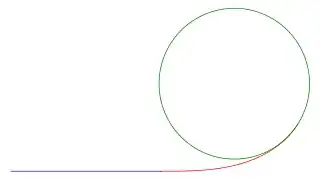
Wikipedia Image
Hghways
On highways, the lanes are wide enough that you can drive a spiral just by moving from one side of the lane to the other. Sometimes this is referred to as, "Straightening out the curve." For this reason, spirals are not used on all curves in highways.
Railroads
One industry where spirals are used extensively is the railroad industry. Cars on a road have the freedom to move from one side of the lane to the other, a train does not have that luxury. A train is guided rigidly by the rails and has no room to deviate.
On railroad tracks, all but very low speed curves have spirals on both sides of the curve. This provides a gentle transition in lateral acceleration. This greatly improves passenger comfort. Spirals are used on freight lines because they also reduce the forces on the track components themselves.
One disadvantage of the use of spirals is that it increases the amount of space required for each curve. Spirals effectively lengthen the curve.


