3

On a datasheet, sensitivity temperature drift (TCs) is specified in %/K.

I read this as "the percent change per kelvin".

Is this is simple as this sounds, or is there a reason for using kelvin over celsius?

I.e if TCs=0.01 and the temperature changes from 20C to 30C, or from 293K to 303K, then the total percentage change is 0.1%?

user975326
  • 133
  • 5
  • 3
    "*... or is there a reason for using Kelvins over Celsius?*". Yes. The 'kelvin' (lowercase) is the SI unit of temperature. The symbol gets a capital 'K'. All SI units named after a person follow this rule: 'V' for volt, 'A' for ampere, 'K' for kelvin, etc. Unlike the degree Fahrenheit and degree Celsius, the kelvin is not referred to or written as a degree. – Transistor May 21 '18 at 22:45
  • It sometimes depends on the data sheet. If all the temperature specifications in the data sheet are deg C, why throw in a K to confuse things? – Crash Magnet Oct 31 '19 at 02:00

2 Answers2

3

Yes, this is the percentage change per kelvin.

Most engineers work in kelvin as some formulae need the absolute temperature such as when calculating the total internal energy, but we sometimes don’t bother such as when dealing with temperature difference, but it was good practice when we were taught it so we continue to use K...

Transistor
  • 9,424
  • 2
  • 19
  • 30
Solar Mike
  • 14,798
  • 1
  • 19
  • 29
2

This is as simple as it sounds - if the reading was 5mA current when the temperature was 20C, and it changed to 30C, with TCs = 0.01, then the reading could be off by as much as:

$$(0.01 \frac{\%}{K})*(30^\circ C-20^\circ C)*\frac{0.01}{\%}*5mA = 0.005mA$$

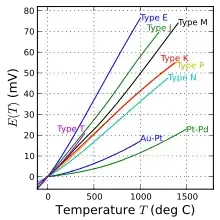
While ISO convention dictates the use of kelvin, inverse kelvin are a derived unit and there is no standard when choosing between inverse degrees Celsius and inverse kelvin - except to avoid having to place a unicode degree symbol (kelvin are standalone without the symbol). Another reason for the notation discrepancy is that some measurement devices, such as thermocouples:
enter image description here

have a semi-non-linear response with respect to temperature. As such, these typically will denote their average change over a large range as per degree Celsius, to hint that it is more of an "average" amount and that more precise thermal drift values can be obtained by reviewing the exact temperature range that is being measured.

Mark
  • 5,333
  • 13
  • 47