13

I am wondering if there is a spring strong enough and light enough to inflate an airtight membrane so that it floats at Standard Temp & Pressure.

As an example, a 10cm cylinder would displace just under 1 gram of air, but a cylindrical spring would have to oppose 162kg of atmospheric force in that configuration. Is there such a thing as a 162kg 10cm cylindric spring that weighs less than 1 gram?

But that's just one spring design. More generally, what spring designs provide the highest rate/weight ratio? What are the current practical limits on spring rate vs spring mass, and using what materials?

feetwet
  • 1,785
  • 1
  • 15
  • 40
  • I'm not sure I fully understand your question. You speak of a "10cm cilinder" and how much (volume) air it displaces, but not all dimensions are given. And where does that 162kg come from? If you can add a drawing it should help a lot. – Vladimir Cravero Jan 21 '15 at 09:41
  • I think OP might be talking about the spring (which is in a vacuum) exerting force on a membrane, which therefore increases the volume of the spring-membrane system, rendering the entire system buoyant enough to float in the air. – March Ho Jan 21 '15 at 13:42
  • @VladimirCravero: 10cm cylinder is 10cm diameter and 10cm high. 162kg comes from standard barometric pressure ~1.033 kg/cm2 bearing on the top and bottom surfaces of the cylinder, which are on the only compressible dimension in the described system. MarchHo: exactly right! – feetwet Jan 21 '15 at 14:09
  • aw well now I get your question perfectly. I'm no expert, can't really provide a detailed answer but... There's no way such a thing can exist now. – Vladimir Cravero Jan 21 '15 at 14:27
  • 1
    Isn't it fairly obvious that helium gas is rather effective at this? Other than that, I don't understand the question. What rigid, yet weightless material is your "cylinder" made of? – Dave Tweed Jan 21 '15 at 17:55
  • I voted to close because, as Vladimir Cravero pointed out, there is no answer to this question. – cKrug Jan 21 '15 at 19:08
  • @cKrug The question is about the state of the art in springs. The fact that the state of the art _may_ fall short of my fanciful application doesn't render the question unanswerable. – feetwet Jan 21 '15 at 20:00
  • 2
    Well, there is an answer to this question, at least from today engineering standpoint: No. - But a detailed one has to explain why. The subquestion, which is the lightest spring with the highest k is okay. – JHK Jan 21 '15 at 20:01
  • Ok, those are good points. I removed my vote, not that it was making a difference. I guess I was the only one who saw it the way I did, so I was probably wrong to close. Thanks guys. – cKrug Jan 21 '15 at 20:15
  • I think developing a shell light enough and hard enough that can be emptied of air would be a more viable avenue of research; besides, it doesn't need to be perfect vacuum: fill it with hydrogen or helium, then reduce pressure to its durability (buckling) limits. I was thinking about bubbles made of hardening polymer similarly to soap bubbles. Pierce, remove air, seal, and you have a lighter-than-air filler material. – SF. Jan 23 '15 at 12:42
  • @SF.did you read the material constraints section of the vacuum airships page I linked in my answer? – jhabbott Jan 24 '15 at 03:24
  • @jhabbott: I did, but I'm talking about a "hybrid" solution. Soap bubbles can be frozen solid. Hydrogen-filled soap-bubbles float up. Replace soap water with a polymer which can polymerize rapidly and has sufficient surface tension to form bubbles, and you have floating solid bubbles. Now if you reduce the internal pressure to the point of buckling you just increase lift. – SF. Feb 04 '15 at 20:45
  • I don't know about springs, but I think you might be interested in using electric charge or magnetism rather than a spring. I posted a similar question with electric charge [here](http://physics.stackexchange.com/questions/201987/levitating-capacitor) before I realized that there are already answers to such questions... – Chandran Goodchild Feb 04 '16 at 18:28

1 Answers1

4

I know your question is about springs, but I don't think that springs are the answer to your desired application.

As you mentioned, the inward force from air pressure is very large so not only do you need a strong spring, but you also need a material for the paneling which is light and can take those kind of forces. Additionally, you would need to evacuate the air that seeps in through the material at a molecular level. There are good reasons lighter-than-air aircraft use a low-density gas inside the balloon:

  1. There is no requirement for exceptionally strong and light materials.
  2. There is no (or very low) pressure differential between the inside and outside, and therefore no tendency for the gas to escape or the atmosphere to seep in.

You may be interested to read the Wikipedia article on vacuum airships, in particular the section on material constraints. This shows the proof that even using a strong shape (hollow sphere) made of diamond, the pressures are too great for the structure to withstand once you thin it down to be light enough to become buoyant.
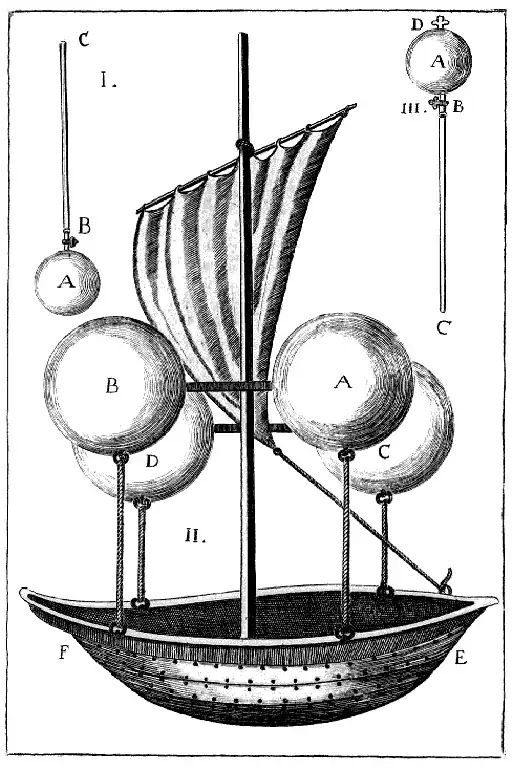
Flying Boat

Given that in these ideal conditions it is not possible, it seems unlikely that a spring in a balloon would be possible. However, the Wikipedia article does leave open the possibility that if the wall of the sphere was not solid, for example if it was made of a honeycomb structure, then it may still be possible.

Update: Apparently the maths has been done to show this is possible in theory, but it's not clear if it has been successfully implemented.

jhabbott
  • 5,990
  • 6
  • 29
  • 63
  • Together with my coauthor, I did the math (finite element analysis) for a sandwich sphere with honeycombs. It is possible to make a vacuum balloon with currently available materials. Please see the reference to our patent application in the Wikipedia article. – akhmeteli Apr 30 '15 at 01:08
  • @akhmeteli oh wow, that's very cool! Could you please edit the question where I said "I have no idea if anyone's done the math" to cite yourself as having done the math and what your conclusions were. As far as I can tell the comment in the article still stands... it *may* be possible but hasn't been done yet? Your edit will have to be approved, and you'll get some rep for it. Oh, and welcome to Engineering.SE :) – jhabbott Apr 30 '15 at 01:43
  • Thank you for the kind words. I am not a big fan of editing anything though, but if you have questions, I will try to answer. – akhmeteli Apr 30 '15 at 01:55