3

It's not exactly my area of expertize and I've spent a couple hours ears deep in norms, and I'm not really sure if what I found is correct (the figure I found was to the order of 1$\mu$m).

When using standard (off-the-shelf, not specialized) threaded pin / bolt and a matching nut for a lead-screw actuator, what degree of imprecision (free lengthwise movement of the actuator without the shaft turning) can I expect coming from the allowed technical tolerances of the thread? In other words, what amount of play can I expect between a threaded bolt and nut?

To be more specific, I realize there will be movement from lateral and longitudinal flexibility of the shaft; from its mounting bearings; from its axial twist against the drive; and probably quite a few other sources, but I'd like to know this specific factor - how much of a "give" or play can there be in a thread, allowing movement of the nut along the bolt without either of them turning.

I suspect that this changes with the shaft diameter, so a table or a method to calculate the amount of play for most common metric threads would be preferred for an answer. If that's too difficult or doesn't exist, I'm most interested in the value for M10 thread.

SF.
  • 6,153
  • 23
  • 43
  • I'm not sure I can answer this, but for general clarification, are you asking how much the bolt and nut can move axially (along the length of the bolt) in relationship to each other with no relative rotation between the two? – Trevor Archibald Feb 02 '15 at 16:35
  • I've seen reports of 16 thread/" rods being off by 0.1 thread – ratchet freak Feb 02 '15 at 16:44
  • What kind of off-the-shelf thread are you talking about? Usually for simple leadscrews we use ACME screws in America, at least. The tolerance you are talking about is called 'backlash' (when turning the shaft the opposite direction does not move the nut.) – Ethan48 Feb 02 '15 at 18:29
  • @TrevorArchibald: Yes, that's it. (Pessimistic variant; I remember the tolerance norms were the type of "+0, -x", meaning there being exactly zero space between the two was still within norm) – SF. Feb 02 '15 at 18:29
  • @Ethan48: Normative technical thread conforming to EU norms (as opposed to "special-purpose" like for extreme temperature conditions, increased hardness, or special thread profiles). Yes "backslash" would be what I'm looking for (if it's an angular measurement, finding the linear counterpart would be trivial knowing the thread spacing.) – SF. Feb 02 '15 at 18:41
  • (...and sorry for not using proper technical terminology. I know most of the proper terms but... not in English.) – SF. Feb 02 '15 at 18:42
  • @SF. No Problem. What I'm trying to ask is, are you planning to use a thread that is the same shape as you would use to bolt two things together (eg. ISO 262 M6X1), or a specific leadscrew thread shape (trapezoidal, like DIN 103?) – Ethan48 Feb 02 '15 at 18:55
  • 1
    @Ethan48: Generic (like ISO 262). That's a hobby project and price and accessibility of components is a high priority. I won't find a DIN 103 leadscrew in my local hardware store. – SF. Feb 02 '15 at 19:14
  • 1
    In 3D printers, M8 threaded rod is often used for the Z axis. To help cope with backlash, they often use 2 nuts: 1 at the bottom of the carriage and another at the top but with spring tension against the carriage. – Krista K Feb 03 '15 at 00:31

2 Answers2

3

Standard threads are classified for accuracy by a tolerance class (You can see a bit about the metric thread fit classes at http://www.amesweb.info/Screws/IsoMetricScrewThread.aspx .) The screws you find at your local hardware store will probably be a relatively rough tolerance class, meaning that the threads are designed to have some gap between them, and also that there will be a large variation in the dimensions of each individual bolt or nut.

Unfortunately for your question, the requirements of the tolerance classes are about the diameter of the crests and roots (and therefore truncation) of each thread, but not about the accuracy of the pitch (how many threads are in any given unit length.)

So there isn't a great theoretical way to predict the backlash for a thread that wasn't really designed for use as a leadscrew. I think your estimate of 1μm is pretty optimistic though. For point of reference, a well maintained manual milling machine might have as little as .001" (~25μm) and that's using a specifically designed leadscrew with a low-backlash design. A less pristine machine could easily have as much as .010" (~.25 mm) of backlash. If your design is using a smaller diameter leadscrew, there will be some improvement, but the tolerances designed in standard threadforms will make it worse. So your backlash would probably be on the order of magnitude of .1mm - 1mm for common leadscrew sizes (with 10mm being at the lower end of that range.)

There are strategies for dealing with backlash, including a 'split nut' where two separate nuts are coupled together and with either spring tension or fine adjustment forced into contact with opposite edges of the bolt thread. The other strategy is to always approach the target from the same side. If this is an option for you, it is the simplest way to solve the problem of backlash without any materials cost.

Ethan48
  • 4,511
  • 16
  • 41
2

The link provided by Ethan48 added a lot of informations.

Tolerance classes:

Note : * 6g is normally selected for commercial external (bolt) threads.

Note : ** 6H is normally selected for commercial interrnal (nut) threads.

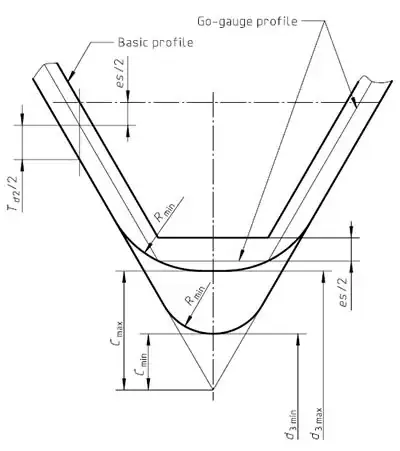
ISO metric screw external thread root contour according to ISO 965-1 for positions e, f, g

The amount of movement allowed for external thread would be determined by axial counterpart to (radial) $T_{d2}/2 + es/2$. With thread angle of 60 degrees that would be 3/4 the value, and with movement in either direction, the value should be doubled, so the part of backslash from external thread would be ${3 \over 4} (T_{d2} + es)$. The part for internal thread would be analogous, ${3 \over 4} (T_{D2} + EI)$.

As result, the backslash = ${3 \over 4} (T_{d2} + T_{D2} + es + EI)$

Let's take a common commercial M10x1 bolt with tolerance of 6g and a matching 6H nut. That's 1mm pitch.

According to iso 965-1:

es = 26 $\mu m$
EI = 0

$T_{D2}$ = 150 $\mu m$
$T_{d2}$ = 112 $\mu m$

${3 \over 4} \cdot (150+112+26+0) = 216 \mu m$

So, for typical M10x1 commercial screws most pessimistic backslash is 0.216mm. In reality it should be significantly lower as the parts are always manufactured with some safety margin from the normative limits (manufacturers aiming at halfway the allowed range), and even small mismatch (imprecision) of thread pitch between the thread and the bolt further reduces the backslash. (and of course, over time, wear will make it worse.)

SF.
  • 6,153
  • 23
  • 43
  • ...and after thorough lecture of the norm, I never found any tolerances for the pitch itself. How precisely does turning the nut 1000 times convert to it traveling 1m? – SF. Feb 03 '15 at 11:01