The thickness of hull plates is goverened by regulatory agencies (DNV/GL, ABS, LR, BV, etc.). Outside hull is rolled alloyed steel shaped to minimize water resistance and internal is flat steel.
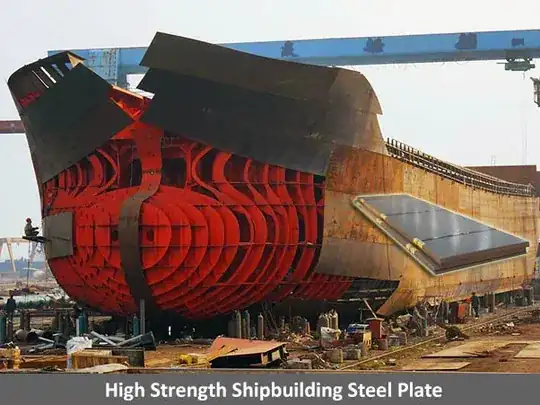
From Shipbuilding Steel Plates - Ansol Steel
Modern steel plates have much higher tensile strengths than their predecessors, making them much better suited to the efficient construction of large container ships. ... High corrosion resistant steel plate is perfect steel type for oil tanks, and when used in shipbuilding, ship weight is less for the same capacity ships, fuel cost and CO2 emission can be reduced.
From Steels for Shipbuilding
In shipbuilding, there is usually a trade off in the use of material and complex structures. Typically, a complex structure requires more labour and fabrication than a simpler structure, which uses more material. There is also a tradeoff between using more complex structure and the lighter weight of the vessel, as a lighter ship can carry more cargo for a given volume, requires less power and therefore fuel to operate. A lighter ship thus provides more revenue for lower operating costs. The simple structure and heavier ship, offsets these benefits by the lower construction man hours and thus labour cost.
The dimensions of the Ever Given:
- Displacement 265,876 t
- Length 399.94 m
- Beam 58.8 m
- Draught 16.0 m (maximum)
- Depth 32.9 m
The displacement is the amount of water that is displaced by ship. Exceed that and ship cannot float.
Rough area of hull is 2 * 400m * 33m + 59m * 33m = 50,000 m^2
Additional mass = 50,000 m^2 * (251.2 - 235.5)kg/m^2 = 785,000 kg (roughly)
Numbers are from Shipbuilding Steel Plates - Ansol Steel
If we go from 30mm (235.50 kg/m^2) to 32mm (251.20 kg/m^2), the additional steel would decrease cargo capacity by 785 t. At 24t/TEU (fully loaded), this would be 32 less containers.
The displacement is fixed by the dimensions of the ship. Designers must balance everything which goes into the ship with water displacement. The hull: keeps the water out; resists wind and wave action (hurricane force); resist corrosion (with alloys, painting and cathodic protection). No matter how strong the hull is made, it will still be peeled away if made contact with rocks: Exxon Valdez and Costa Concordia or ice: Titanic. These accidents are not common.
Thinner plates makes shaping, cutting and welding easier but it means the ship is more flexible.
MOL Excellence - Bending of Underdeck Passage


