0

I read the definition of Isometric Projection from this pdf that Projection plane intersects each coordinate axis in which the object is defined (principal axes) at the same distant from the origin.

But we know that projection plane is 2D plane where z-component is either zero or constant, so how is it possible projection plane intersects each coordinate axis?This sentence isn't understanding in that pdf ,what does it mean?

I also read that Projection vector makes equal angles with all of the three principal axes.Isometric projection is obtained by aligning the projection vector with the cube diagonal.

My question is how to visualize projection from 3D space to projection plane(2D) where diagonal(projection vector) makes equal angle with 3 principal axis of below image(which is projection plane image after projection): enter image description here

Sahitto
  • 113
  • 6
  • Can you imagine that object in your mind? – Solar Mike Dec 27 '21 at 08:21
  • @Solar yes.. But how can I imagine Projection vector makes equal angles with all of the three principal axes? – Sahitto Dec 27 '21 at 08:23
  • @Ajn if I kept projection plane at xy plane then z=0 and if I kept projection plane at z=c(any constant) then both possible cases where z-component is either zero or constant. Am I correct? – Sahitto Dec 27 '21 at 11:50
  • @Ajn " The cube aligned with the axes would look like a square in the view that you mention"--- from my last comments ? – Sahitto Dec 27 '21 at 11:55
  • @Ajn how could you say in 2D plane z isn't constant? It sounds like absurd. – Sahitto Dec 27 '21 at 12:36
  • @Ajn in 2d plane any components must be constant – Sahitto Dec 27 '21 at 13:01
  • @Ajn I am waiting for your image. – Sahitto Dec 27 '21 at 22:26
  • Let us [continue this discussion in chat](https://chat.stackexchange.com/rooms/132654/discussion-between-ajn-and-ponting). – AJN Dec 28 '21 at 01:57
  • @Ajn please join in chat. – Sahitto Dec 28 '21 at 09:17
  • 1
    Cross-posted: https://engineering.stackexchange.com/q/48937/7678, https://math.stackexchange.com/q/4342892/14578. Please [do not post the same question on multiple sites](https://meta.stackexchange.com/q/64068). – D.W. Dec 30 '21 at 20:08

3 Answers3

2

It might be easier to read first for axonometric projections, which are projections that the viewing plane is normal to the projections lines (i.e. the observer is at infinity)

enter image description here enter image description here

Figures: Axonometric projection source:Indian Insitute of Technology )

The isometric projection is a axonometric projection that all angles ($\alpha, \beta, \gamma$) are equal. More precisely $\alpha= \beta= \gamma = 54^o 44''$).

Hopefully, the first image provides an explanation to your question:

But we know that projection plane is 2D plane where z-component is either zero or constant, so how is it possible projection plane intersects each coordinate axis?

The coordinate system XYZ intersects with the viewing plane and tuning the angles results in different distances from the origin of XYZ.

NMech
  • 23,917
  • 2
  • 30
  • 72
  • how diagonal makes equal angle, it's not visualize by me... Please make one cube where we see $\alpha, \beta, \gamma$ angle between diagonal and principal axis? – Sahitto Dec 27 '21 at 09:13
  • 1
    @ponting, I am afraid I can't think of an efficient time wise method to try to explain this (it would require a lot of drawings, or videos or animations because its a 3d problem which is projected into 2d). As a alternative I suggest you search and look at youtube the term "isometric projection fundamentals" or axonometric projection. Hopefully the use of videos and other animated material will make it easier to perceive. – NMech Dec 27 '21 at 09:27
  • could you provide any video link by which can perceive? – Sahitto Dec 27 '21 at 09:30
  • I am afraid I have not looked at all the videos, so I can't really make a recommendation for you. However I did a quick search and saw a few (not many) videos on the subject so you are bound to find something useful. Also another reason I refrain from a recommendation, is that --in my experience-- something that was useful for me, does not necessarily have the same value for someone else (and since I don't have a clear perspective on that I don't feel qualified to recommend). – NMech Dec 27 '21 at 09:34
  • I know you could make yourself. Please do this. – Sahitto Dec 27 '21 at 09:36
  • @Ponting given the answers, you can take it from there. – Solar Mike Dec 27 '21 at 10:52
  • @solar it's difficult to perceive; I have been failing. – Sahitto Dec 27 '21 at 10:55
2

But we know that projection plane is 2D plane where z-component is either zero or constant, so how is it possible projection plane intersects each coordinate axis?

The projection plane is like the film / sensor of a camera. It can be in any orientation, not necessarily parallel to the (global) XY plane. So the projection plane can intersect all three axes except in cases where the plane happens to be parallel to (global) XY or (global) YZ or (global) ZX plane.

I used the qualifier "global" for the axes and the planes since one can define another set of XYZ axes where the X and Y axes lie on the projection plane (horizontal and vertical direction). In that frame, Z axis is by definition, perpendicular to the screen / projection plane.

My question is how to visualize projection from 3D space to projection plane(2D) where diagonal(projection vector) makes equal angle with 3 principal axis ...

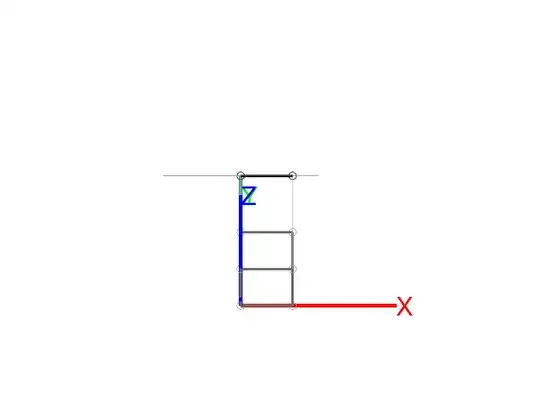
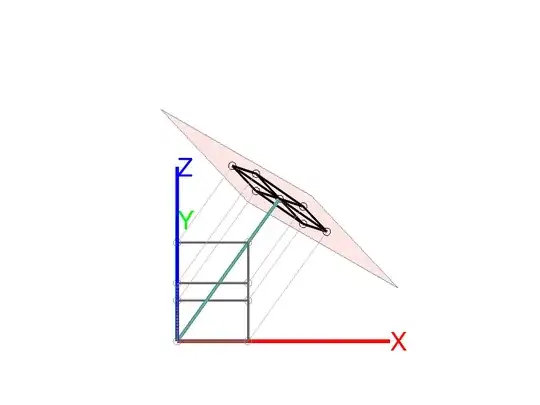
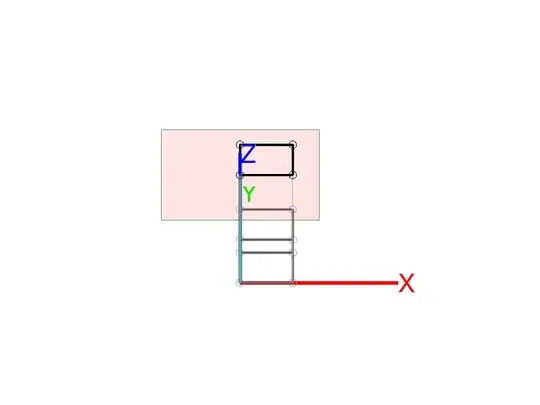
Below are three images which may help you visualize the projection plane, the projection vector / direction and the projected image. The global X, Y ans Z axes are colored red, green and blue. The cube is aligned to the global axes. The projection plane is shown in translucent red square. The projected image of the cube is thick black lines.

The projection direction is shown as thin teal line. Note that all the vertices are extended running parallel to the projection direction until they hit the projection plane.

  1. Projection plane is parallel to the XY plane. The cube appears as a square to when projected on the projection plane.
  2. Projection direction lies 45° to the Z and Y axes. Projection plane intersects Z and Y axes. The cube appears to be two rectangles when projected on to the plane.
  3. Projection direction is equal angle from all three axes; i.e., projection direction is the vector $[\frac{1}{\sqrt(3)}, \frac{1}{\sqrt(3)}, \frac{1}{\sqrt(3)}]^T$ and the angle with each axis is 54.736°. Projection plane intersects all three axis at equal lengths (not visible in the figure attached). Note that, for this projection, the projection line passes through diagonally opposite corners of the cube.

1.projection along Z direction
2.projection along equal angles to Y and Z axes

3.projection along equal angles to all three axes

EDIT

I also read that Projection vector makes equal angles with all of the three principal axes...

Please elaborate how you get $[1/(√3),1/(√3),1/(√3)]^T$

Let the projection vector be a unit vector $\hat{n} = [a, b, c]^T$. The angle that each axis makes with this vector is given by the dot product.

$$ \cos\theta = \hat{x} \cdot \hat{n} = [1,0,0]^T \cdot [a,b,c]^T = a\\ \cos \psi = \hat{y} \cdot \hat{n} = [0,1,0]^T \cdot [a,b,c]^T = b\\ \cos \phi = \hat{z} \cdot \hat{n} = [0,0,1]^T \cdot [a,b,c]^T = c\\ a = b = c \quad \text{since} \quad \theta \triangleq \psi \triangleq \phi $$

Since $\hat{n}$ is a unit vector, $a^2+b^2+c^2=1^2$. So, $a = b = c = \frac{1}{\sqrt 3}$.

We can find this vector in another way also;

aligning the projection vector with the cube diagonal

The cube diagonal is $[1, 1, 1]^T$. This vector has length $\sqrt 3$. So the corresponding unit vector is $[\frac{1}{\sqrt 3}, \frac{1}{\sqrt 3}, \frac{1}{\sqrt 3}]^T$

AJN
  • 814
  • 1
  • 4
  • 11
  • in your second animation the projection plane seems to be intersects X-axis(red line) also. How can we say it only intersects Y and Z-axis? – Sahitto Dec 28 '21 at 13:46
  • "projection direction is the vector $[1/(√3),1/(√3),1/(√3)]^T$"-- this is not understanding. Please elaborate how you get $[1/(√3),1/(√3),1/(√3)]^T$? – Sahitto Dec 28 '21 at 14:10
  • I have an above two confusion, please say this. – Sahitto Dec 28 '21 at 14:42
  • In the second animation, the projection *plane* doesn't intersect the X axis. But for some particular *viewpoint* in the animation, it may *look like* it is intersecting. – AJN Dec 28 '21 at 15:16
  • you mean T mean transpose? – Sahitto Dec 28 '21 at 15:17
  • yes. T for transpose. – AJN Dec 28 '21 at 15:18
  • 1
    You are right. That is because, I didn't generate the animation with infinite plane. Only a small square cut from the infinite plane is shown in the animation. Perhaps, if the plane was made bigger or infinite sized, it would be more apparent. – AJN Dec 28 '21 at 16:07
  • in diametric projection the projection vector is also diagonal?how visualize it makes 2 equal angle with coordinates axis.? – Sahitto Dec 28 '21 at 16:09
  • Let us [continue this discussion in chat](https://chat.stackexchange.com/rooms/132668/discussion-between-ajn-and-ponting). – AJN Dec 28 '21 at 16:12
1

This may be the easier way.

  • Let's say you have a corner of an object at coordinates x,y,z of 2,3,3.

  • You pic a corner randomly on your projection plane as the origin.

  • Then you have the three-axis at 120-degree angles with the Z-axis being the vertical, X-axis going -30 from horizontal, and Y-axis at 210 degrees from the horizontal axis.

  • then you transfer your x,y,z, or 2,3,3 exactly the same length on your Isometric axis. You repeat this for all corners or points of your object.

  • Now if you need to mark a point along with the X-axis 1.5 units down on one edge you need to move 1.5 on the X-axis and leave the rest of the coordinates.

Soon you will see more clearly how parallel lines project and get the idea of how to measure off the projection.

kamran
  • 21,714
  • 2
  • 18
  • 38