1

I made an electric furnace as a university project. It can heat up air inside up to 1000 degrees Celsius. It's not fully sealed so some air can escape from small gaps. Not sure if this would cause a problem or not later on, but water always drips a few times from certain places during operation.

The furnace is encased in a steel plate. I noticed that the top case has a lot of dew (from vapor condensation I assume) once the furnace started to heat up.

  • What causes water to drip?
  • Is it a dangerous thing?
  • If it is, is there a way I can do to prevent it, or at least lessen the frequency?

IDK if this help, I live near the equator and the humidity here is always high.

Edit: added observation and pictures (read from top to bottom)
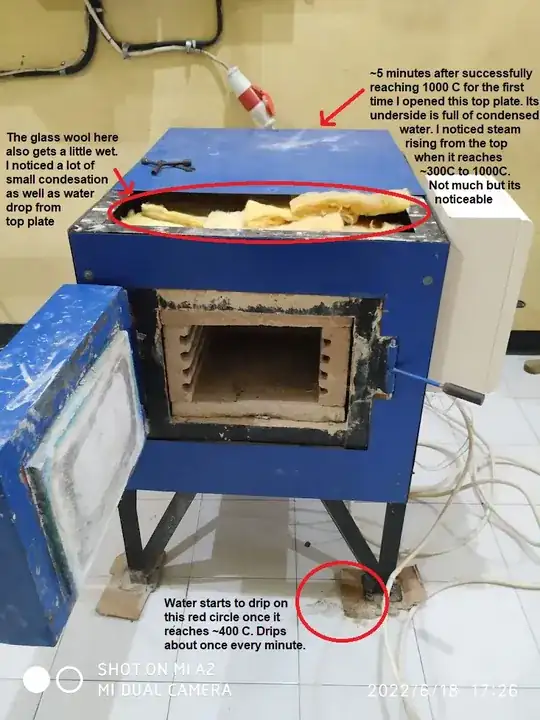
~5 minutes after successfully reaching 1000 C for the first time I opened this top plate. Its underside is full of condensed water. I noticed steam rising from the top when it reaches ~300C to 1000C. Not much but it's noticeable.

Wasabi
  • 13,048
  • 7
  • 35
  • 61
Bramble
  • 11
  • 2
  • Hot air absorbs a lot of water I guess? And when that air escapes and cools it can no longer hold onto the water and the water falls out? Just like rain. Also, Boji. – DKNguyen Jun 19 '22 at 19:50
  • Never a good idea to mix water and electricity - the results can be shocking. Making sure of insulation is very important. – Solar Mike Jun 19 '22 at 20:33
  • I have never seen something heat up and drip water. Something else is going on here. What is the source of water? – Tiger Guy Jun 19 '22 at 22:54
  • @TigerGuy my best guess is from humidity but I don't know the exact mechanism, which is why I ask this question – Bramble Jun 20 '22 at 05:23
  • @TigerGuy Water can drip from car engine exhaust pipes. – DKNguyen Jun 20 '22 at 05:23
  • @DKNguyen, sure that's a combustion product. Electric ovens don't drip. – Tiger Guy Jun 20 '22 at 06:16
  • @Bramble, humidity doesn't condense out via heating. somehow you have put water into the system – Tiger Guy Jun 20 '22 at 06:18
  • @TigerGuy, my hypothesis is that super heated air can carry much more vapor (not even sure if this is correct). Those escaped air then come in contact with cooler metal case which drop it's temperature considerably but lower it's ability to hold vapor, so some of the vapor condenses. Enough condensation would then result in dripping water. – Bramble Jun 20 '22 at 06:49
  • 2
    @bramble, the water has to come from somewhere, like it was in the oven before you started it up. Unless you are running it in a bathtub the water has to come from somewhere, you cant absorb water from air. – Tiger Guy Jun 20 '22 at 07:56
  • @TigerGuy are you really sure about that? Anything to back that up? I'm just looking to see if my hypothesis is false or true. – Bramble Jun 20 '22 at 08:06
  • Please post both photos and schematics, and give us some info on when water shows up compared with startup, reaching design temperature, staying at temperature for maybe a day or two,.... – Carl Witthoft Jun 20 '22 at 13:31
  • @CarlWitthoft I do not have the schematics since the electrical side done by my friend but I will provide the photos – Bramble Jun 20 '22 at 14:02
  • @Bramble, consider it a closed system. The only water in the system is already in the air. The only way to get water to condense is to cool the existing air below its dew point. – Tiger Guy Jun 20 '22 at 20:44
  • @TigerGuy electric ovens can drip round the door seal, as water evaporated from food reaches cooler metal (or more obviously when baking bread with a pan of water in the bottom because we want the steam). So the question - you're right - is that the water has to come from somewhere. But I wonder about some of the materials. – Chris H Jun 22 '22 at 15:19
  • @TigerGuy should be possible; heat air in an uneven manner. Hot air steals water from colder air. Then cool the hot air in an environment separated from the cold air. – Abel Jun 27 '22 at 20:00

2 Answers2

1

You built it wet

Obviously you used damp materials to build the furnace. Turn it to a low setting and run it until it's dry. It's no more complicated than that.

Tiger Guy
  • 5,369
  • 6
  • 17
  • If you used cartable refractory , it was not fully cured. A big deal in some industry; We had a lab tech whose job was to determine how fast new refractory could be heated without cracking because of steam. – blacksmith37 Jun 22 '22 at 17:48
1

You need to consider what materials were used in the lining and in the insulation. Some materials can give off a lot of water on heating, without being wet to start with. This is called water of crystallisation

For example, dry plaster of Paris, when heated, will undergo a chemical change and give off water which is bound into the crystal structure. Gypsum plaster is well known for this, which is why I use it as an example. If you've used firebricks this won;t apply as they've already been fired and don't take up water chemically (they may still do so physically if stored somewhere wet).

Glass wool, being made of silica, can hold quite a lot of water physically stuck to the surface.

Of course once the water, whatever the source, gets into the air in the insulation, it will either escape as steam, or condense on the walls and flow out.

Heating alone can't cause condensation, only evaporation, but you have cooling at the walls. However that's cooling to (above) ambient so you can't condense out water that the ambient air can hold.

One other possibility: it's not unknown for furnaces of different types to this to use water-cooling around ports or controllers. Both leaks in the cooling loop and condensation on water-cooled parts could conceivably leads to wetness. But I reckon you'd know about and water-cooling loops and would have told us.

Chris H
  • 276
  • 1
  • 5