-1

What I want is after the needle reaches 60 it should go back to 0 in the way showed in the image enter image description here

The mechanism should preferably be based on gears which convert a steady continuous rotation to the shown slow CW turning and fast return.

here is a youtube video to show what i mean

https://www.youtube.com/watch?v=XV7ij1cICHM

  • Check out valve lapping tools – Solar Mike Jul 11 '22 at 12:47
  • that is not what i meant still thank you – ABO M7TRAF Jul 11 '22 at 20:27
  • 1
    What are you really trying to make? What is the real problem you are trying to solve. Put all the information into your question - not hidden in the comments. If you ask a good clear question you will get good clear answers. – Transistor Jul 11 '22 at 21:05
  • 1
    You do this by making the driving gear do what you want, like with a stepper motor. I don't think anyone these days except tinkerers would try to do this mechanically. – Tiger Guy Jul 11 '22 at 21:34
  • You drive two half gears together in opposite directions and together use them to drive a main gear. One half gear mates the main gear in one half of the rotation and the other half gear mates with the main gear in the other half. Also works if you replace the main gear with a rack. – DKNguyen Jul 12 '22 at 00:41
  • @user287001 a quick return mechanism then. Like https://www.youtube.com/watch?v=s-ZCbn4IVK8 – joojaa Jul 12 '22 at 07:08
  • @user287001 you took it way to complicated it should be a watch and represent the time and what i want is the needle to go from 0 to 60 and then going back from 60 to 0 in 3 seconds and me question is how can i achive this kinda of movment through gears – ABO M7TRAF Jul 12 '22 at 10:37
  • @ABOM7TRAF, why do you not put this information in your question as requested? It is still only a little bit of extra information. What is the time taken to go from 0 to 60? Is it always the same? What is it supposed to represent? Does the input shaft rotate continuously? Etc., etc., etc. – Transistor Jul 12 '22 at 19:08
  • ok i am going to repost the question with full details.sry i am new here this was my first post – ABO M7TRAF Jul 12 '22 at 19:56
  • There are books and websites that show mechanical mechanisms in detail. http://507movements.com/ https://hackaday.com/2016/02/29/2100-mechanical-mechanisms/ https://mechamechanisms.com/ https://engineerfix.com/a-complete-guide-to-linkage-mechanisms/ https://cs448m.github.io/lectures/machines/doc/3.pdf – Jim Clark Jul 13 '22 at 15:10
  • @JimClark thank you very much bro – ABO M7TRAF Jul 13 '22 at 20:04

1 Answers1

0

Seemingly no flood of answers. You get one which is simplified from a noise making toy named "cog rattle" or "ratchet" enter image description here
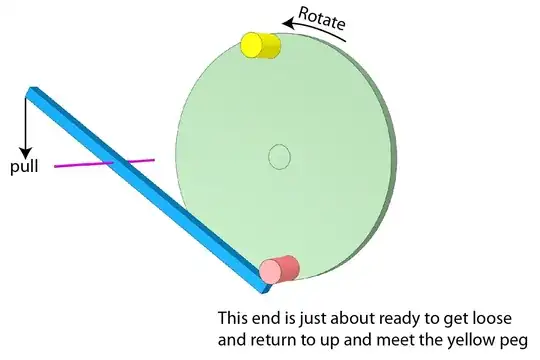
The red peg is just starting to push down the rightmost end of the blue bar. The rotation needs some force because there's a down pulling spring, a counterweight or a torsional spring which tries to rotate the bar counterclockwise around the purple axis.

In the next image the green disk has rotated 90 degrees CCW, so the blue bar has turned about 50% of its range.
enter image description here

In the next image the blue bar is in its extreme position. When the green wheel rotates a little more the bar returns to its initial position (= pulled by the gravity or a spring):
enter image description here

The left end of the blue bar could be the needle of your linked meter. In that case the counterweight or down pulling tension spring must be replaced by a spiral or torsional spring which generates the needed return torque around the purple axis.

BTW the numeric scale of the needle isn't linear with this method. Every shown needle position value must be calculated separately.

The practical turning range of the blue bar is much less than 180 degrees. If you need more, for ex. 270 degrees, the blue bar cannot be the needle. You need a gearbox or lever to extend the range.

  • this might be what i am searching for do u have a yt video taht explains it in more deapth ? – ABO M7TRAF Jul 12 '22 at 19:58
  • My instrument has only 2 teeth in the rotating wheel, but it allows quite long forth and back swinging stud when compared to the diameter of the wheel. More common is this version, https://en.wikipedia.org/wiki/Ratchet_(device) which has more teeth but the forth and back swinging part is short or it turns only a few degrees. As noise maker it is often like this https://www.youtube.com/watch?v=rkYJh5KinOA –  Jul 12 '22 at 20:13