37

The campus where I work has a long covered walkway (~.5 mile) which has several labeled pipes running under the roof (chilled water, fuel oil, air...). All of the pipes run dead straight except for the natural gas lines, which have little loops spaced about every 250ft, as seen in the attached image (the lowermost, yellow line. There's another natural gas line hidden above all the others, which also does the same thing.)

The line isn't branching at these points, and there doesn't seem to be any need to divert the pipe in order to support it. I've looked at some building codes to see if I could find a reason (or even a requirement) to insert these.

Any ideas as to what these are? It's driving me batty!
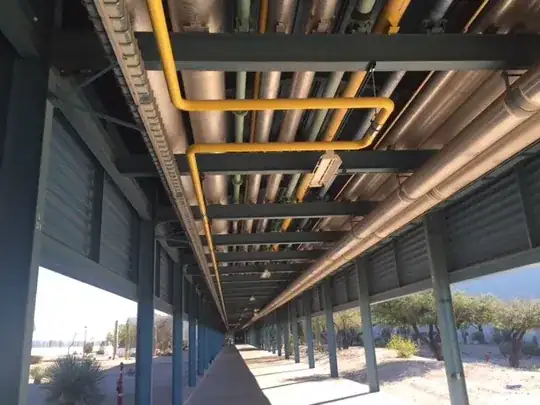
enter image description here

Fred
  • 9,562
  • 11
  • 32
  • 44
Gretchen
  • 473
  • 1
  • 4
  • 5
  • 1
    Nice question. How many bends are there? – HDE 226868 Feb 09 '15 at 22:55
  • 2
    HDE: About 10, over the whole length of the walkway (I haven't counted exactly) – Gretchen Feb 09 '15 at 22:59
  • 2
    Interesting question. My guess is that it is to allow for thermal expansion, but I don't have any idea why only the natural gas lines would need it. Perhaps they are made of a material that has a larger dl/dT. – Chris Mueller Feb 09 '15 at 23:10
  • Sometimes thermal expansion loops are the answer, sometimes [expansion joints](http://www.mercergasket.com/expansion_joints.htm) are the answer. I've noticed that the natural gas line is the smallest diameter, and containing a potentially corrosive chemical against rubber (methane), the decision was likely to use expansion loops instead of expansion joints. Believe me, schools are full of red tape to get into - someone looked at this thing. – Mark Jun 24 '15 at 16:44

2 Answers2

35

The loops are known as expansion loops. They need to be placed in pipelines to enable the pipelines to contend with thermal expansion and contraction and other forces that can affect the pipeline.

They are typically placed in gas pipelines, irrespective of when the gas is hot or cold - natural gas or steam.

The following quote is from Pipeline Design. It's near the end of the page under Pipe Expansion and Supports

Steel piping systems are subject to movement because of thermal expansion/contraction and mechanical forces. Piping systems subjected to temperature changes greater than 50°F or temperature changes greater than 75°F, where the distance between piping turns is greater than 12 times the pipe diameter, may require expansion loops.

Such loops are not only used in gas pipelines and are used in pipelines that convey other fluids such as oil. Pipes transporting liquid fluids can use other expansion control devices such as single slip expansion joints or bellow type expansion joints.

Accommodating Thermal Expansion in Pipes

Pipeline Safety

Ben Trettel
  • 986
  • 1
  • 5
  • 11
Fred
  • 9,562
  • 11
  • 32
  • 44
  • Perhaps the gas lines have the expanders because they are more critical, a gas leak is more problematic than a leak from some of the other fluids/gases. – Jiminion Feb 10 '15 at 06:40
  • 2
    @Fred: There are some less optimistic explanations: The gas pipeline is made to the code, requiring these turns, while the rest is was built in the most straightforward, 'naive' way either because rules of making these lines were unregulated at the time, or someone managed to sneak it through the red tape. Considering the gas pipe runs below the duct, I believe it might have been added later and made to the code, as opposed to the rest. – SF. Feb 10 '15 at 11:37
  • @SF. If you can provide evidence for your "less optimistic explanations" & your "belief" please do so. (1) Expansion loops have been put into pipes for decades - they are safety features. (2) Codes are established by experts, if expansion loops are in the code it is so that the pipe can expand & contract, it's not for decoration. Such loops increase the length of pipelines & their cost. (3) If if wasn't safe to have all the pipes running under the roof as they do they wouldn't be there, the buildings approval inspector wouldn't allow it. – Fred Feb 10 '15 at 12:07
  • @Fred: Just today the news revealed the upper floor of the most prestigious and modern sports/events object in my city is a deathtrap for 6000 people in case of fire. The smoke removal system simply doesn't work. The organization inspecting it refused to issue the approval, but somehow the investor managed to produce one (somehow) and submitted it to the top-level inspection, and the object was approved and started hosting huge events shortly before the elections last year. Considering top-level corruption, I don't expect guilty will be found, and faults may be removed... eventually. – SF. Feb 10 '15 at 12:37
  • ...so these things happen, and not just in small forgotten farms where homebrew tinkerers make them, but in objects that house many thousands of people. Regulations and ethics is one thing, business, politics and simple incompetence are another. Someone screwed up making that system, and then the higher-ups swept it under the rug, to open the object on schedule. – SF. Feb 10 '15 at 12:49
  • [link to Google-translated article](https://translate.googleusercontent.com/translate_c?act=url&depth=1&hl=en&ie=UTF8&prev=_t&rurl=translate.google.com&sl=pl&tl=en&u=http://www.gazetakrakowska.pl/artykul/3745993,krakow-afera-nowe-koszta-utajniona-umowa-i-syn-komendanta,id,t.html%3Fcookie%3D1&usg=ALkJrhjaEV6a-119GsjuEcxYGRl5YX_3OA) – SF. Feb 10 '15 at 12:49
  • 1
    @SF. I fail the see what an inadequately or incorrectly installed smoke removal system in a stadium in Poland & potentially corrupt officials in Poland has to do with a piping system in the USA & in particular one gas pipeline with a loop in it. The picture shown in the question is nothing unusual; I have seen similar arrangements of pipes over the past 3-4 decades. I first learnt about pipe expansion loops when I was studying engineering over 30 years ago. There is an engineering reason why that loop is there. – Fred Feb 10 '15 at 13:47
  • @Fred: Of course that loop is in there, as it should be. I'm talking about the remaining pipes, with no apparent signs of axial expansion joints in the visible length of these pipes, and definitely no expansion loops. Considering the description, at least some of them may be subjected to similar thermal stresses, so why would only the gas line get them? What is the engineering reason why such loops, or these axial expansion joints are NOT present on the remaining pipes? – SF. Feb 10 '15 at 13:57
  • @SF. The question was only about the pipe with a loop. About the other pipes (1) they are of different diameters (2) they are of different styles, suggesting different metals & different wall thicknesses - the green pipe has 2 flanges visible, the silver pipes are all smooth (3) we don't know what the pipes are carrying, or whether the fluids are under pressure. Expansion loops are used for gas pipelines - the yellow pipe in question is a gas pipeline. These loops can be used for liquid fluids but inline expansion joints can also be used in these pipes. Just because there isn't an inline ... – Fred Feb 10 '15 at 14:14
  • expansion joint visible in these pipes in the picture doesn't mean they are somewhere else in those pipes. Because the pipes aren't the same they most likely aren't under the same pressure & stresses and any expansion joints will be placed where needed, not necessarily within close proximity to expansion joints in neighbouring pipes. – Fred Feb 10 '15 at 14:19
  • Let us [continue this discussion in chat](http://chat.stackexchange.com/rooms/21008/discussion-between-sf-and-fred). – SF. Feb 10 '15 at 14:19
  • 2
    Just to clarify - there is another natural gas pipeline above all the other pipes, obviously put in with the rest. I'm assuming the secondary pipeline was put in due to increased demand. That older pipe also has the thermal expansion loops, so I don't think the fact that the other pipes are all straight is due to a difference in code, so I imagine it's the different materials/contents. – Gretchen Feb 10 '15 at 17:21
1

If the other pipes are carrying liquids with a greater specific heat coefficient then they would not be expected to experience the same temperature ranges, i.e. the water pipes will be at some average of the outside temp and the water temp. A low-pressure gas line would be made of lighter material and the gas inside would equalize with the external temp pretty quickly. So the code for a gas line and a liquid line (or a light pipe and a heavy pipe) might be different.

Expansion joints are often used for exposed liquids pipelines, like the Alaska pipeline, that are subject to temperature extremes and cover long distances. Buried pipelines don't experience the same range of temperature and don't normally employ expansion loops.