I would like to find out if it is possible to reduce the divergence of a red laser pointer beam from 40 degrees to 1 degree.
@Ruslan wrote on October 3 2013 that because the active zone of a red diode laser has diameter of order of several micrometers the divergence of a red laser pointer beam is currently 40 degrees.
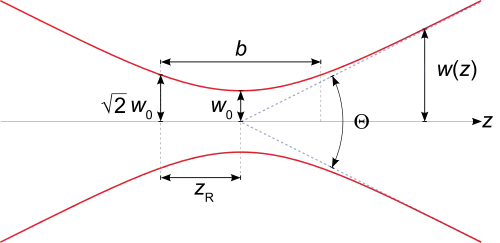
Due to Heisenberg's uncertainty principle $\Delta\times\Delta p \gtrsim \hslash/2$, one can't really make a quantum have zero momentum in any direction. So you can't say that photons go in the same direction - this is just a simplified description of laser operation. In reality, the thinner the beam, the higher the divergence.
Compare e.g. a DPSS laser (e.g. green laser pointer) with a diode laser (e.g. a red laser pointer).
In a DPSS laser the active material will have diameter of order of hundreds of micrometer, and the exiting beam will start from even smaller diameter for various reasons. The divergence is quite small: if you remove the collimating lens, your light image from a green laser pointer will be several centimeters after the light goes several meters. Divergence angle would be $\lambda/d = 532\ \mathrm{nm}/100\ \mu\textrm{m} \approx 0.3°$.
If you try doing the same with a red laser pointer, you'll see that its light diverges quite a lot: after going several centimeters in direction of propagation, it'll already give image of several centimeters. The reason for this is that active zone of diode laser has diameter of order of several micrometers. This makes output beam quite thin, making Δx small and thus Δp high, and this is what leads to high divergence. Divergence angle would be $\lambda/d = 640\ \mathrm{nm}/1\ \mu\textrm{m} \approx 40°$. Actual angle would depend on which transverse direction you select, because active zone is ∼10× longer in one direction than in another.
In general, the thicker your starting laser beam, the more collimated it is, so if you manage to make a (visible wavelength) laser with beam starting at 1cm thickness, you'll have almost perfectly collimated laser beam.
I would like to know if there is a method to enlarge the active zone of a red diode laser from a diameter of several micrometers to 30 micrometers. Also, could a lens with short focal length be used to reduce the divergence of a red laser pointer beam from 40 degrees to 1 degree?