Now I cannot possibly know what the exact reason is here, but there is another very good reason, not mentioned so far, for using this kind of method: throwing off a disassembler during static analysis.
The mechanics of call $+5 have been discussed, so I'll assume they are known by now - otherwise refer to the other answers. Basically like with any call on IA-32, the return address (the address of the instruction following the call) gets pushed to the stack and the ret instruction inside that called function will presumably return to that address, assuming the stack hasn't been smashed meanwhile.
Fooling static analysis tools
What will even a sophisticated disassembler such as IDA do when it sees a ret opcode? Well, it'll assume that the function boundary has been reached. Here's an example:

Now this not being the first time I've seen such a thing, I went on and deleted the function, so IDA stops assuming it's a function boundary. If I then tell it to disassemble the very next byte (0Fh) I get this:

What the disassembler cannot realize and what is the reason why interactive disassemblers like Hopper and IDA rock so much, is that something special is going on here. Let's look at the instructions:
51                                      push    rcx
53                                      push    rbx
52                                      push    rdx
E8 00 00 00 00                          call    $+5
5A                                      pop     rdx
48 83 C2 08                             add     rdx, 8
52                                      push    rdx
C3                                      retn
0F 5A 5B 59                             cvtps2pd xmm3, qword ptr [rbx+59h]
89 DF                                   mov     edi, ebx
52                                      push    rdx
48 31 D2                                xor     rdx, rdx
The leading bytes are the actual bytes in the binary, followed by their mnemonic representation. But pay special attention to this part:
call    $+5
pop     rdx ; <- = ADDR
add     rdx, 8
push    rdx
retn
We get the address ADDR in rdx after the pop instruction was executed. We know this much from the description of the mechanism in the other answers. But then it gets odd:
add rdx, 8
we add ... uhm eight bytes to that address (ADDR+8) and then we push it to the stack and call ret:
push    rdx
retn
If you remember how a call works then you'll remember that it pushes the return address to the stack, then passes execution to the called function and that function later calls ret in order to return to the address found on the stack. This knowledge is being exploited here. It manipulates the "return address" before "returning" to it. But looking back at our disassembly we find to our surprise (or not ;)):
E8 00 00 00 00                          call    $+5
5A                                      pop     rdx
48 83 C2 08                             add     rdx, 8
52                                      push    rdx
C3                                      retn
0F 5A 5B 59                             cvtps2pd xmm3, qword ptr [rbx+59h]
Let's count the opcode bytes (in your tool you can also do the math via the offsets, if you're so inclined):
5A4883C20852C30F
But wait a minute, that means we're literally passing execution to the middle of this peculiar cvtps2pd xmm3, qword ptr [rbx+59h]? That's right. Because 0Fh is one of the prefixes used when encoding instructions on IA-32. So the programmer has tricked our disassembler, but he won't trick us. Undefining that code and then skipping the 0Fh prefix we get:
51                                      push    rcx
53                                      push    rbx
52                                      push    rdx
E8 00 00 00 00                          call    $+5
5A                                      pop     rdx
48 83 C2 08                             add     rdx, 8
52                                      push    rdx
C3                                      retn
0F                                      db  0Fh
5A                                      pop     rdx
5B                                      pop     rbx
59                                      pop     rcx
89 DF                                   mov     edi, ebx
52                                      push    rdx
48 31 D2                                xor     rdx, rdx
or:
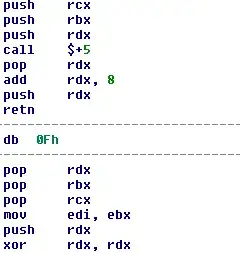
The apparent single four-byte instruction 0F 5A 5B 59 is now revealed to be bogus and instead we have to ignore the 0F and then resume at 5A, which decodes as pop rdx.
Check out Ange's excellent opcode tables here to find out more about how instructions get encoded on IA-32.


