12

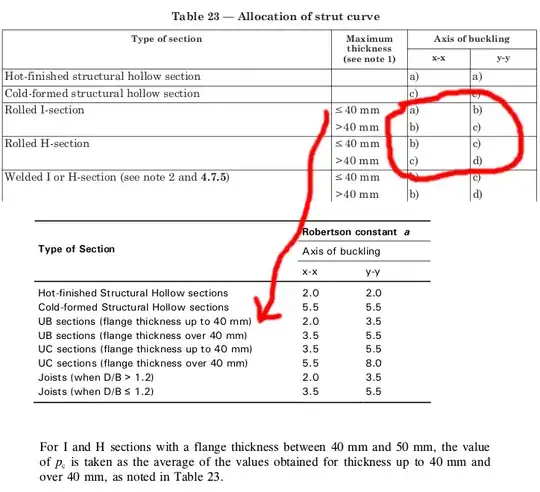
According to BS5950, a beam section can be classified as plastic, semi-compact, compact or slender. For the same section area, a H-beam can take axial compression (without buckling) better than an I-beam, and as such, uses a different strut curve in the code:
enter image description here

Now, I understand that a H-beam has a wider flange compared to an I-beam, but at what point, precisely, does this transition from I- to H- occurs? For example, is a 400x300 (depth x width) beam considered a H- or an I-beam?


Update:

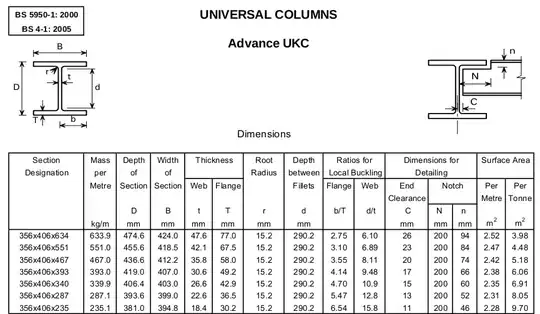
Extracted from BS5950 guide, the following table shows H-beams (also known as universal columns, some of which with depth greater than width. This is the reason why I don't believe the differentiation is so straight forward.
Section Property Table

  • I'm probably wrong, but I'd say the only difference between these two is orientation at which they should be used... – Slovakov Feb 21 '15 at 11:36
  • @AndyT, please refer to Table 23 above to understand why this H- or I-beam distinction needs to be clear. Also, from the SCI guide to BS5950, it is quite clear that Universal Column refers to H-beam and Universal Beam refers to I-beam. – Question Overflow Feb 28 '15 at 12:31

1 Answers1

10

BS5950-1:2000 Clause 1.3.23 defines an H-section as having "an overall depth not greater than 1.2 times its overall width", and Clause 1.3.25 defines an I section as having "an overall depth greater than 1.2 times its overall width".

Note that at exactly a ratio of 1.2, it would be an H section not an I section.

AndyT
  • 3,135
  • 12
  • 28