6

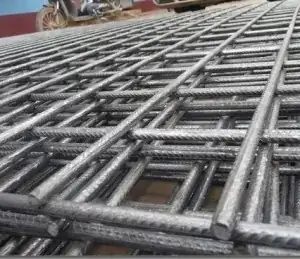
I have an welded steel mesh, like in the following image.

steel mesh.

  • Material: steel
  • Diameter of the wires: 4mm
  • Mesh: 15x15cm

I found the following information about the welds:

  • the minimal relative strength of welds in shear: Fms = 4.4kN

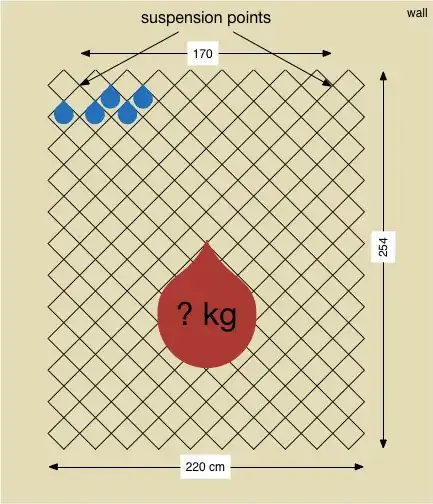
I want cut out an rectangle from this mesh (dimensions are on the following image) and want hang it on the wall, suspended by two screws.

Now I want hang to the welding points some weights. (on the image the drop-like things) :), in two scenarios:

  1. uniformly attach to each welded point some weight (like the blue "drops")
  2. attach one big weight to the center (the red drop)

enter image description here

  • What is the weight I can hang on the mesh (in both scenarios) without significant structural deformations (2% elongation)?

  • I don't want have broken welds. Will the welds fracture before the bars yield or vice versa? At what load will the first of these failure modes occur?

Also, i'm looking for some "guide" how it should be calculated - if it is possible to do in easy (read: "idealized") form, without specialized software. I would be happy to calculate it myself, but need some "how to". Understand than using finite-elemets or such will give most precise result, but is here some "easier/simpler" way?

Air
  • 3,221
  • 4
  • 24
  • 46
clt60
  • 173
  • 5
  • 2
    "significant structural deformation" isn't specific enough to allow high quality answers to this question. Either a number needs to be provided as the limit, or you need to ask a slightly different question (e.g. what is the maximum load it can take before structural failure?). – AndyT Mar 11 '15 at 13:25
  • 2
    Unfortunately this question is going to be very difficult to answer anyway. Steel mesh is not designed to be loaded like this. The welds at the connections are only intended to keep the bars at right angles during handling - they are not intended to take any load. I therefore suspect it will be very difficult to find out what size the welds are and therefore what load they will take. I would be very surprised if the welds do not fail before the bars, and hence without knowing the weld size it's impossible to calculate the capacity. – AndyT Mar 11 '15 at 13:29
  • Just a note that I've converted OP's failure condition of 5cm total elongation to 2% (based on dimensions given), to ease the calculation at an intermediate link. – Trevor Archibald Mar 11 '15 at 16:39
  • @jm666 One other issue: If you can find it, I would add more specifics to the type of steel. "Steel" is only slightly more specific than "metal." There are many different compositions and treatments that all affect the mechanical properties. – Trevor Archibald Mar 11 '15 at 16:40
  • @TrevorArchibald - DOH. I (partially) understand your point of view (as you can see, i'm an stack overflow veteran), but as like in many programming tasks, don't need to be handled EVERY POSSIBLE situations. Please, remember - it is for my **GARDEN** and not for the space shuttle. And future users will read the answer, where probably will included the calculated steel type. I was in hope, than engineers knows from what steel are the standard welded meshes are produced. Also, when the answer will tell me: for the steel XXXX will break at XXX kg - i will be *perfectly HAPPY*. – clt60 Mar 11 '15 at 16:53
  • @jm666 I understand you're not looking for a complete true to life simulation, but the type of steel is one of the most fundamental parts of the problem, in the same vein as the dimensions of the rod. We can make assumptions that probably won't be far off, but I'm thinking that where you're purchasing these from might have at least some clue as to the type of steel used. – Trevor Archibald Mar 11 '15 at 18:07
  • 2
    I agree with @AndyT - I'm not sure more information about the steel would be nearly as useful as more information about the welds. Since this is for a light application with not much of a safety concern, perhaps it would be reasonable to make some assumptions and check the worst-case scenario. – Air Mar 11 '15 at 18:18
  • Note that the mesh in the image cannot be hung as indicated in the diagram without a significant amount of cutting. Are you sure you can hang your mesh in that orientation? – Air Mar 11 '15 at 18:21
  • @Air I'm aware this. It is no problem, I have the necessary tools, including welding machine (will need two 2x3m sheets to cover the area). :) Anyway, maybe would be nice to know how the orientation affects the maximum load. – clt60 Mar 11 '15 at 18:40
  • I concur with the other comments here in regard to the welds likely being the controlling factor in this situation. As has been pointed out above by Andy, the welds are not meant to be structural. They are simply meant to hold the mesh in shape until it can be placed and then encased in concrete. With respect to you request for an idealized, simple way to solve this problem. Treat the mesh as a truss. You have your load and your support points. Now use method of sections or method of joints to calculate the stress in each individual bar as a function of your total load. Done, and by hand! – William S. Godfrey- S.E. Apr 05 '15 at 10:24
  • @WilliamS.Godfrey A month ago I added the weld strength - 4.4kN in *shear* mean, i need attach 400kg to the one weld to break it. To be honest - from the "engineering" stack-exchange site i was expected an answer like: If each weld can hold 400 kg, the sum of "blue drops" must be bellow 800kg - otherwise the welds at suspension point will break and 400kg for the "red drop" otherwise weld at the attach point will break. It is that easy. Seems, engineers here over-complicating an simple question for an practical (real life) application. Thank you anyway for the comment. ;) – clt60 Apr 06 '15 at 14:38
  • 2
    @jm666, I suggested that you treat the mesh as a truss and go from there. It doesn't get much simpler than that. The reason you are not getting a simple answer as you expected is because the analysis problem as you've defined it is not as simple as it apparently looks at first blush. – William S. Godfrey- S.E. Apr 07 '15 at 14:39
  • 2
    @jm666, I'll tell ya what, you let me know what type of steel that is and I'll give you an incredibly back of the napkin answer utilizing enormous assumptions. – William S. Godfrey- S.E. Apr 07 '15 at 14:49
  • is 2% elongation of steel-carpet stresswise safe? with 45 degrees of the steel bars, would it mean that per-bar elongation can be more than 2% at some points? – Gürkan Çetin Jun 28 '15 at 09:07
  • Also, how will you hang the single-fat-boy? This could be the single point of failure. – Gürkan Çetin Jun 28 '15 at 09:09

1 Answers1

3

The weld points will definitely be the limiting factor (think about a cargo net, where both the strands and joints are flexible, but usually the strands are straight and the joints are at whatever angle they need to be at to let the strands be straight.)

Since the "shear" strength is listed in linear kN I'm going to assume that that is the effective strength of one joint resisting a force that would slide one bar along the other.

I'll further assume that the steel used has a tensile yield strength of 370 MPa.

I think a good assumption is that the weld joints can be approximated as having a circular cross section. We can estimate the diameter of the cross section:

$$F=\frac{\sigma}2\,\pi\,r^2$$ $$d=\sqrt{\frac{8F}{\sigma\,\pi}}=\sqrt{8\frac{4.4\,\mathrm{kN}}{370\,\mathrm{MPa}\,\pi}}=5.5\,\mathrm{mm}$$

Well, that's unreasonable...so either those welds are made of some super alloy, or the maximum shear load of those welds is less than 4.4 kN.

Edit:( Actually according to this answer the welds can be significantly larger than the wires so this might not actually be unreasonable. )

In fact the maximum tensile load a 4 mm diameter cylinder of 1018 steel could hold before yielding is about 4.4 kN.

So let's proceed as if the diameter of the weld is 1 mm. Each joint could then handle some torque $\tau$ according to:

$$\tau=\frac{\pi\,\sigma_y\,d^3}{24} \approx 50 \,\mathrm{N\cdot mm}$$

There are approximately 250 joints so the maximum total torque is approximately 62 N·m.

The torque produced by the weight be calculated via Virtual Work:

The elongation of a ridged mesh $\epsilon$ is approximately half the radians of deformation $\gamma$.

The gravitational potential energy gained from a uniformly distributed mass by stretching is:

$$E=\frac12 m\,g\,h\,\epsilon= \frac14\,m\,g\,h\,\gamma$$

$$\tau=\frac{dE}{d\gamma}=\frac14\,m\,g\,h$$

Solving for mass gives:

$$m=250\frac{4\,\tau}{g\,h}\approx 2\,\mathrm{kg}$$

This indicates that if the strength of the welds is close to 1018 Steel, and the weld diameter is close to 1 mm then it wouldn't even come close to holding up its own weight (8 kg) when hung at a 45 degree angle. However, if the weld points are 2 mm in diameter then it could hold 15 kg allowing it to support its own weight with a safety factor of 2.

If this were my project I would do destructive testing on one weld joint to see how much torque it takes to yield it. That would allow you to plug in for $\tau$ and get a reasonable estimate for the maximum load.
Rick
  • 1,295
  • 8
  • 23
  • Wow, great answer. The value is taken from a technical sheet, what says "minimal strength of the welds in sheer" (for different diameters, the following: for d3.5mm=3.8kN, d3.8=4kN, d4=4.4kN, d4.5=4.8kN, d5=5.2kN). Also, for the tensile strength of the wire material: 450Ma. resistance welding, cold brittleness 60/6d. /whatever is it mean :) :)/ You provided many equations - great. Accepting. Finally someone who really thinking about the solution, not only commenting. Thank you very much. :) – clt60 Aug 02 '15 at 15:18